We may earn an affiliate commission when you visit our partners.
Course image
Steve Ballinger, MBA

Artificial intelligence (AI) is rapidly transforming the workplace, and with so many new AI-powered tools and platforms emerging, it can be difficult to know where to start. That's where this course comes in.

How would you like to:

Read more

Artificial intelligence (AI) is rapidly transforming the workplace, and with so many new AI-powered tools and platforms emerging, it can be difficult to know where to start. That's where this course comes in.

How would you like to:

  • Create an entire slide deck by entering a few prompts?

  • Create social media posts automatically with AI help?

  • Write entire text items from emails to blog posts to work papers and more with simple prompts.

  • Create stunning custom images by describing what you want in text and then have AI create your image for you. No artistic ability required at all.

  • Create and edit videos simply by editing text. No more steep learning curves to edit complex audio wave forms. If you can edit a PowerPoint you can edit using the AI tools shown in the course.

  • Have AI create first drafts in so many ways and styles that you can edit and add on to as you desire.

  • Plus, so much more.

What students are saying about Steve's AI Courses:

  • "Excellent course for learning the many different aspects of AI." -Eric M

  • "Great step by step examples with continuing depth of the same topic. Loads of practical utilization." -Joseph B

  • "I love Steve's presentations. He makes learning fun and engaging. It's like having a chat with him, rather than sitting in a class." -Karen S

  • "I really enjoyed the way Steve has explained everything it’s a kind of fun learning experience for me." -Aakanksha S.

No more staring at a blank page trying to figure out how to start.

No more cumbersome development. Let AI do the heavy work so you can focus on the core parts of your job.

In this comprehensive course, you'll learn about the latest and greatest AI-based tools and platforms that can help you automate tasks, save time, and make better decisions at work.

Even if you're not tech-savvy, this course is designed to be easy to follow and I demonstrate everything. You'll learn the basics of AI and how it can be used to improve your productivity at work, step-by-step.

Who is this course for?

This course is for anyone who wants to learn how to use AI to improve their productivity at work so they can then focus on what they do best.

Benefits of taking this course:

  • Boost your productivity: AI-based tools and platforms can help you automate tasks, save time, and make better decisions, all of which can lead to increased productivity.

  • Become more efficient: AI can help you streamline your workflow and eliminate unnecessary steps, making you more efficient and productive.

  • Get ahead in your career: As AI becomes more and more prevalent in the workplace, those who have the skills to use it effectively will be in high demand.

You will elarn the most important and effective AI tools that you can use immediately. All the tools are demonstrated step x step so you can get started right away.

Your Instructor:

With over 500,000 students from over 200 countries on Udemy Steve Ballinger can help you succeed. Steve has 12 courses on ChatGPT and AI plus is a frequent presenter on AI webinars and events as an AI thought leader around using AI in the work place.

Enroll today and start using AI to boost your productivity at work.

Many thanks and I hop to see you in the course.

-Steve Ballinger

+ + + + + + + + + + + + + + + + + + +

The Future of AI and its Benefits for Everyday Work

Artificial intelligence (AI) is rapidly transforming the world around us, and the workplace is no exception. AI-powered tools and technologies are already being used to automate tasks, improve efficiency, and make better decisions. As AI continues to develop, it is poised to have an even greater impact on our everyday work lives.

One of the most significant benefits of AI for everyday work is its ability to automate repetitive tasks. This can free up workers to focus on more strategic and creative work. For example, AI-powered chatbots can handle customer service inquiries, allowing human customer service representatives to focus on more complex issues. AI can also be used to automate tasks such as data entry, scheduling, and invoicing.

Another benefit of AI is that it can help us to improve our decision-making. AI systems can analyze large amounts of data and identify patterns that humans may not be able to see. This information can then be used to make better decisions about everything from product development to marketing campaigns.

AI can also help us to improve our productivity. AI-powered tools can help us to work more efficiently by automating tasks, providing insights, and suggesting best practices. For example, AI-powered writing assistants can help us to write better emails and reports by suggesting grammar and style corrections. AI-powered time tracking tools can help us to identify and eliminate time-wasting activities.

Overall, the future of AI for everyday work is very bright. AI has the potential to make our work lives easier, more efficient, and more productive. As AI continues to develop, we can expect to see even more innovative and groundbreaking applications of AI in the workplace.

ChatGPT, Google Bard, and Bing AI are all large language models (LLMs) that have been trained on massive datasets of text and code. They can generate text, translate languages, write different kinds of creative content, and answer your questions in an informative way.

What Is ChatGPT, Google Bard, and Bing AI

Here is a brief overview of each LLM:

  • ChatGPT is developed by OpenAI and is currently available in beta. It is known for its ability to have engaging and informative conversations with users.

  • Google Bard is developed by Google AI and is still under development. It is designed to be a general-purpose LLM that can be used for a variety of tasks, including generating text, translating languages, and writing different kinds of creative content.

  • Bing AI is developed by Microsoft and is currently integrated into the Bing search engine. It can be used to answer questions, generate text, and translate languages.

All three LLMs are still under development, but they have already learned to perform many kinds of tasks, including:

  • Following instructions and completing requests thoughtfully.

  • Answering questions in a comprehensive and informative way, even if they are open ended, challenging, or strange.

  • Generating different creative text formats, like poems, code, scripts, musical pieces, email, letters, etc.

LLMs like ChatGPT, Google Bard, and Bing AI have the potential to revolutionize the way we work and live. They can be used to automate tasks, improve efficiency, and make better decisions. They can also be used to create new forms of art and entertainment.

There are many AI tools that use ChatGPT, Google Bard, Bing AI and others such as Dall-E for their foundation and then build on top of that to address a specific need. Like presentation creation AI like Tome and Decktopus to create not just the template but a draft of the actual content based on prompts you enter. Then you can edit and make it your own presentation deck but do not need to start from a blank page. We will learn about Tome and Decktopus in the course plus many other key AI tools you can use at work.

Ready to dive in? Enroll now.

Enroll now

Here's a deal for you

Save money when you learn with a deal that may be relevant to this course.
All coupon codes, vouchers, and discounts are applied automatically unless otherwise noted.

What's inside

Learning objectives

  • Identify appropriate ai tools for specific workplace tasks and challenges.
  • Demonstration of the key ai tools anyone can use.
  • Have ai create presentation decks with just by entering a text prompt.
  • Create stunning custom images with a text prompt. tools like midjourney, dall-e, adobe firefly, microsoft designer and more.
  • Use new canva tools to accomplish many design tasks in moments.
  • Create and edit videos videos easily with ai.

Syllabus

Awesome AI Tools (Jump to the lesson that interests you the most or go in order)
Welcome To The Course
Presentations Fast With Tome AI
Presentations Fast With Decktopus AI
Read more

Traffic lights

Read about what's good
what should give you pause
and possible dealbreakers
Covers AI tools like Tome and Decktopus, which can rapidly generate presentation decks from simple text prompts, saving significant time and effort
Explores AI tools such as Midjourney, Dall-E, Adobe Firefly, and Microsoft Designer, enabling users to create custom images using text prompts, regardless of artistic skill
Features Descript, an AI-powered video editing tool that simplifies the editing process by allowing users to edit videos through text manipulation, making video editing accessible to those without specialized skills
Includes instruction on using Canva's AI tools, which can help users accomplish design tasks quickly using text prompts, streamlining the design process and enhancing productivity
Examines ChatGPT, Google Bard, and Bing AI, which are large language models that can automate tasks, improve efficiency, and make better decisions, potentially revolutionizing work processes
Addresses the issue of AI 'hallucinations,' which is when AI tools like ChatGPT, Google Bard, and Bing AI provide incorrect information, which is important for users to be aware of

Save this course

Create your own learning path. Save this course to your list so you can find it easily later.
Save

Reviews summary

Practical ai tools for non-technical work

According to learners, this course offers a highly practical and easy-to-understand introduction to using AI tools in a work context, specifically designed for those without technical backgrounds. Students frequently mention the variety of tools covered, such as ChatGPT, Canva, and Descript, and appreciate the step-by-step demonstrations which make implementation straightforward. The instructor's approach is described as engaging and easy to follow. While the fast-evolving nature of AI means some specific tool interfaces or features might change over time, the course is widely viewed as an excellent starting point for boosting productivity and understanding the potential of AI for everyday tasks.
AI tools evolve quickly, potentially affecting content.
"Because AI is moving so fast, I know some tool details might change soon."
"While the concepts are great, I anticipate needing to look up updates for the tools."
"Understanding that AI evolves means this course is a foundation, not the final word."
Instructor makes learning enjoyable and clear.
"The instructor's explanations were clear and easy to digest."
"His teaching style kept me engaged throughout the course."
"Steve makes complex topics feel simple and fun to learn."
Helpful demos show exactly how to use tools.
"The step-by-step demos made it easy to follow along and try the tools myself."
"Really appreciated seeing how each tool worked with clear examples."
"Demonstrations were the most valuable part for understanding practical use."
Introduces a wide array of AI-powered applications.
"It was great to see so many different AI tools demonstrated in one place."
"Opened my eyes to AI tools beyond just ChatGPT."
"The course provided a useful overview of tools for writing, images, and video."
Designed well for non-technical users.
"I have no technical background but found the course incredibly easy to follow."
"This course is perfect if you're new to AI and want to use it without code."
"Felt comfortable learning about these tools even as a complete beginner."
Learn tools for immediate work application.
"I can already see how to use these AI tools in my daily workflow."
"The examples were very relevant to common workplace tasks."
"Gave me practical strategies to save time and be more efficient at work."

Activities

Be better prepared before your course. Deepen your understanding during and after it. Supplement your coursework and achieve mastery of the topics covered in AI: Awesome AI Tools For Work (Non-Technical) with these activities:
Review AI Terminology
Familiarize yourself with common AI terms to better understand the course content and discussions.
Browse courses on Artificial Intelligence
Show steps
  • Find a glossary of AI terms online.
  • Read through the definitions and examples.
  • Take a short quiz to test your understanding.
Review 'AI for Dummies'
Gain a foundational understanding of AI principles before diving into specific tools.
Show steps
  • Obtain a copy of 'AI for Dummies'.
  • Read the introductory chapters covering basic AI concepts.
  • Take notes on key definitions and examples.
Follow Tutorials on Prompt Engineering
Improve your ability to craft effective prompts for AI tools like ChatGPT and DALL-E.
Show steps
  • Search for online tutorials on prompt engineering for AI image generation.
  • Practice writing prompts for different AI tools.
  • Compare the results of different prompts and refine your technique.
Four other activities
Expand to see all activities and additional details
Show all seven activities
Create a Presentation Using Tome AI
Solidify your understanding of Tome AI by creating a presentation on a topic related to your work.
Show steps
  • Choose a topic relevant to your work or interests.
  • Use Tome AI to generate a presentation outline and initial slides.
  • Edit and refine the presentation content and design.
  • Present your presentation to colleagues or friends for feedback.
AI-Powered Content Creation Project
Apply the AI tools learned in the course to create a complete content piece, such as a blog post or marketing campaign.
Show steps
  • Define the scope and goals of your content project.
  • Use AI tools to generate text, images, and videos for your content.
  • Edit and refine the AI-generated content to meet your specific needs.
  • Publish or share your content and track its performance.
Review 'Working with AI'
Explore real-world examples of AI implementation in the workplace to understand its potential and limitations.
View Working with AI on Amazon
Show steps
  • Obtain a copy of 'Working with AI'.
  • Read case studies relevant to your industry or interests.
  • Reflect on how these examples can inform your own use of AI tools.
Curate a List of AI Resources
Deepen your understanding by compiling a list of useful AI tools, articles, and tutorials.
Show steps
  • Identify AI tools and resources relevant to your work.
  • Organize the resources into categories (e.g., image generation, text editing, presentation creation).
  • Write a brief description of each resource and its benefits.
  • Share your list with colleagues or online communities.

Career center

Learners who complete AI: Awesome AI Tools For Work (Non-Technical) will develop knowledge and skills that may be useful to these careers:
Content Creator
A content creator develops engaging material for various platforms. This course helps content creators by introducing AI tools to automate content creation, such as generating social media posts or writing blog posts. The course demonstrates how AI can assist with tasks like creating stunning custom images by describing what you want in text, thereby enhancing visual content. This is particularly relevant for content creators looking to streamline their workflow and produce high-quality content efficiently. Learning how to leverage AI tools like those taught in this course allows a content creator to focus on strategy and creativity.
Social Media Manager
Social media managers oversee a company's online presence across various platforms. This course helps social media managers by introducing AI tools that can automate content creation and scheduling, saving time and improving efficiency. The course shows how to create social media posts automatically with AI, and generate engaging visuals using text prompts, enhancing the visual appeal of social media content. This is especially helpful for social media managers looking to stay ahead of trends and maximize their impact. Moreover, the course may help a social media manager leverage AI tools to create more targeted and effective campaigns.
Marketing Manager
Marketing managers develop and execute marketing campaigns to promote products or services. This course helps marketing managers by providing them with AI tools to automate tasks, analyze data, and improve decision-making. The course demonstrates how AI can assist in creating marketing materials, such as presentations and social media content. The ability to create stunning custom images by describing what you want in text is also useful for visual marketing strategies. This course may help a marketing manager leverage AI to streamline workflows and create more effective marketing campaigns.
Digital Marketing Specialist
Digital marketing specialists implement online marketing strategies. As AI continues to transform digital marketing, this course helps digital marketing specialists by introducing AI tools that can automate content creation, improve ad targeting, and analyze campaign performance. The course demonstrates how to create social media posts automatically with AI, and generate engaging visuals using text prompts. This enables the digital marketing specialist to optimize digital campaigns and improve return on investment. This course may help a digital marketing specialist leverage AI to boost productivity and improve overall marketing outcomes.
Instructional Designer
Instructional designers create educational materials and courses. This course may help instructional designers by demonstrating how AI tools can assist in generating content, creating visual aids, and editing videos. The course's coverage of tools that create presentation decks from prompts can greatly enhance the speed at which instructional designers can put course materials together. This is particularly valuable for instructional designers seeking to create engaging and effective learning experiences. An Instructional Designer can leverage the AI tools showcased to improve the quality and efficiency of their work.
Technical Writer
Technical writers create documentation for technical products and services. This course may help technical writers learn how to use AI to create first drafts of documents and edit text. By streamlining the initial writing process, AI can free up technical writers to focus on accuracy and clarity. Knowledge of AI tools for document creation, especially those covered in the course, is increasingly valuable in technical writing. This approach allows the technical writer to concentrate on the nuances of technical communication.
Training Specialist
Training specialists develop and deliver training programs for employees. This course may help training specialists by introducing AI tools that can automate content creation and presentation design. The course's exploration of tools like Tome AI and Decktopus for creating presentations can be particularly useful. This automation capability saves time. By allowing AI to handle the preliminary work, a training specialist can concentrate on customizing the content to meet specific learning objectives.
E-Learning Developer
An e learning developer creates online courses and training programs. This course may help e learning developers by showcasing AI tools that can automate tasks such as generating content, creating visuals, and editing videos. The ability to create presentation decks rapidly with AI, as covered in the course, is particularly useful for streamlining course development. This can significantly speed up the development process. Learning to leverage AI tools allows the e learning developer to focus on the pedagogical aspects of course design, making the courses more effective and engaging.
Curriculum Developer
Curriculum developers design educational curricula for schools and other institutions. This course may help curriculum developers by showing how AI tools can assist in content creation, lesson planning, and assessment design. The course's demonstration of tools that create presentation decks and custom images from text prompts can be used to enhance curriculum materials. This enhancement can assist curriculum developers in streamlining their workflow and creating more engaging and effective educational content. As AI becomes more integrated into education, familiarity with these tools will be increasingly valuable to a Curriculum Developer.
Corporate Trainer
Corporate trainers conduct training sessions for employees to improve their skills and knowledge. This course may help corporate trainers by introducing AI tools that can automate the creation of training materials and presentations. The course shows how to quickly generate presentation decks with tools like Tome AI and Decktopus, saving a significant amount of time in preparation. This enables the Corporate Trainer to focus on delivering engaging and effective training sessions. Leveraging AI tools also allows for more personalized and adaptive training programs, ultimately enhancing the learning experience.
Knowledge Manager
Knowledge managers are responsible for organizing and sharing information within an organization. This course may help knowledge managers by showcasing how AI tools can automate the summarization of documents, extract key insights, and create searchable knowledge bases. The course's exploration of AI writing tools can be particularly helpful for creating concise summaries and reports. Equipping a knowledge manager with AI tools allows for more efficient information management. This makes knowledge more accessible and useful to employees throughout the organization.
Project Manager
Project managers oversee projects from initiation to completion, ensuring they are on time and within budget. This course may help project managers by introducing AI tools to assist with task management, scheduling, and reporting. The ability to automate the creation of presentations and documents is particularly useful for project updates and stakeholder communication. A project manager may use AI to streamline project workflows and improve overall efficiency. As AI tools become more sophisticated, project managers with AI skills will be in high demand.
Business Analyst
Business analysts analyze data and business processes to identify areas for improvement. This course may help business analysts by providing AI tools that can automate data analysis, generate reports, and create visualizations. The course's coverage of AI writing tools can also assist in creating clear and concise reports. This efficiency allows the business analyst to focus on interpreting data and making strategic recommendations. Equipped with AI skills, the business analyst can provide valuable insights to support business decision-making.
Management Consultant
Management consultants advise organizations on how to improve their performance and efficiency. This course may help management consultants by introducing AI tools that can automate research, data analysis, and presentation creation. The ability to quickly generate presentations with AI is particularly useful for communicating findings and recommendations to clients. A management consultant may use AI to streamline consulting projects and deliver impactful results, giving sound advice. Developing proficiency in AI tools enhances their ability to provide effective and cutting-edge solutions.
Chief Technology Officer
A chief technology officer, typically requiring an advanced degree, leads a company's technological direction and strategy. This course may help a chief technology officer by introducing AI tools that can automate tasks, improve decision-making, and enhance productivity across various departments. The course showcases the latest and greatest AI based tools. While a chief technology officer may not use these tools directly, understanding their capabilities and how they can be implemented is crucial for guiding the organization's technological roadmap. This is an executive level position that leads technological innovation.

Reading list

We've selected 50 books that we think will supplement your learning. Use these to develop background knowledge, enrich your coursework, and gain a deeper understanding of the topics covered in AI: Awesome AI Tools For Work (Non-Technical).
This comprehensive handbook provides a state-of-the-art overview of natural language processing, covering a wide range of topics including machine learning, deep learning, and applications. It valuable resource for researchers, students, and professionals in the field.
The definitive benchmark textbook of modern artificial intelligence, rigorously unifying search algorithms, probabilistic reasoning, knowledge representation, and machine learning into an elegant, coherent agent-based framework.
A monumental foundational text establishing the mathematical, algorithmic, and statistical principles of modern deep neural networks, from linear algebra and optimization to convolutional and sequence modeling architectures.
Olivier Caelen and Marie-Alice Blete walk developers through building production software with the OpenAI API, covering chat completions, function calling, embeddings, and retrieval-augmented generation with clear Python examples.
Provides an exceptionally practical, code-first curriculum that guides engineers from end-to-end data preprocessing and traditional regression pipelines to production deep learning models and generative neural networks.
Is specifically focused on Midjourney, offering a comprehensive guide from setup to advanced prompting techniques. It includes step-by-step instructions and examples, making it highly practical for users of the tool. This book useful reference and learning resource for mastering Midjourney.
Chip Huyen establishes the end-to-end engineering discipline behind ChatGPT-powered products, detailing evaluation pipelines, prompt optimization, RAG architectures, latency reduction, and model adaptation for real-world systems.
Delivers an authoritative mathematical foundation in Bayesian inference, graphical models, and statistical learning algorithms, bridging foundational probability theory with rigorous predictive computational modeling.
This beginner's guide specifically addresses using text prompts for generating AI art with tools like Midjourney. It focuses on practical techniques for improving output through prompt engineering. good starting point for those new to AI art generation and Midjourney.
Guides engineers step-by-step through implementing, training, and fine-tuning complete generative transformer architectures in pure PyTorch, providing crystal-clear low-level insight into modern foundation models.
Wharton professor Ethan Mollick offers an evidence-based roadmap for collaborating with ChatGPT as a daily thinking partner, showing how knowledge workers, educators, and leaders can redesign workflows around generative AI.
Presents the foundational treatise on Markov decision processes, temporal-difference learning, and policy gradient methods that underpin autonomous decision-making and modern post-training alignment workflows.
Examines holistic architectural patterns for designing resilient machine learning infrastructure, addressing data pipelines, real-time feature stores, continual learning loops, and production deployment reliability.
James Phoenix and Mike Taylor codify repeatable prompt engineering patterns for ChatGPT and modern LLMs, bridging zero-shot and few-shot design, chain-of-thought reasoning, and structured output generation for software workflows.
Demystifies practical transformer model implementation through the Hugging Face ecosystem, demonstrating how to fine-tune, optimize, and deploy attention architectures across diverse natural language processing and understanding tasks.
This classic textbook provides a comprehensive overview of speech and language processing, covering topics such as phonetics, phonology, syntax, semantics, and pragmatics. It foundational resource for learners and professionals in the field.
While focused on ChatGPT, this book's principles of prompt engineering are directly applicable to Midjourney and other generative AI image tools. It serves as a practical guide for crafting effective prompts to achieve desired outputs. is useful as a reference tool for improving prompting skills.
Provides a collection of prompts and tips specifically for creating art with AI tools, including Midjourney. It serves as a practical resource for users looking for inspiration and guidance on prompt writing. This book useful reference for generating art with Midjourney and other tools.
Drawing on production experience building AI coding assistants, the authors break down how token windows, context assembly, and iterative prompt refinement turn raw language models like GPT-4 into reliable software tools.
Offers a practical, hands-on approach to generative AI using Python and TensorFlow. It covers various generative models and their implementation, including image and text generation. This book is particularly useful for those who want to gain practical experience in building generative models relevant to DALL-E.
Prompt engineering crucial skill for effectively using models like DALL-E. focuses on the techniques and strategies for crafting effective prompts to guide generative AI models to produce desired outputs. It is highly relevant for practical application of DALL-E.
Richly illustrated visual explanations demystify how ChatGPT-class language models tokenize text, compute attention, and generate responses, paired with hands-on code for semantic search, RAG, and fine-tuning.
Delivers battle-tested operational patterns for serving foundation models, addressing GPU cluster throughput, semantic caching, automated evaluation benchmarks, and continuous latency minimization.
Details an applied architectural methodology for running high-performance open-weights models on local workstations, tackling quantization fidelity, memory bandwidth limits, and prompt assembly trade-offs.
Offers a rigorous theoretical foundation for reasoning under uncertainty, combining graph theory and probability distributions to model complex high-dimensional dependencies across autonomous intelligent systems.
Focused on the 2025 shift from single-turn chat to autonomous workflows, this practical manual demonstrates how to equip GPT-class models with tool use, persistent memory, planning loops, and multi-agent coordination.
Introduces core computational linguistics concepts and practical tokenization, tagging, and syntactic parsing workflows through clear Python examples, establishing strong fundamentals for language analysis.
Paul Iusztin covers the full MLOps lifecycle for LLM applications beyond ChatGPT prototypes, tackling data pipelines, supervised fine-tuning, preference alignment, quantization, and scalable inference deployment.
Synthesizes the five foundational tribes of machine learning into a unified conceptual framework, illuminating how symbolists, connectionists, evolutionaries, Bayesians, and analogizers approach intelligence.
Enterprise architects learn how to integrate OpenAI models and ChatGPT capabilities into corporate systems safely, addressing vector databases, prompt security, cost governance, and responsible AI guardrails.
Adrian Thompson focuses specifically on conversational UX and chatbot engineering with ChatGPT, showing product builders how to design persona constraints, multi-turn dialogue flows, and customer-facing assistants.
Updated for 2025 capabilities, an accessible entry point for non-technical readers looking to master everyday ChatGPT workflows, custom GPTs, multimodal prompting, writing assistance, and workplace productivity.
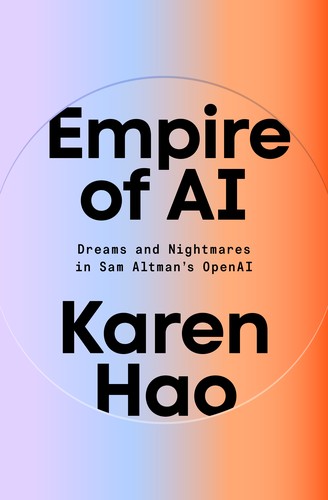
Investigative journalist Karen Hao traces the inside story of OpenAI and the race to build ChatGPT, offering essential context on compute concentration, governance battles, and the geopolitical stakes of frontier AI.
Provides a practical introduction to TensorFlow, a popular deep learning library. It covers topics such as building and training deep learning models, deploying models, and using TensorFlow for natural language processing and computer vision. It valuable resource for learners and professionals seeking to build and deploy deep learning systems.
Provides a practical introduction to natural language processing with PyTorch, a popular deep learning library. It covers topics such as text preprocessing, feature engineering, and machine learning models. It valuable resource for learners and professionals seeking to build and deploy NLP systems.
Provides a hands-on introduction to machine learning using popular Python libraries such as Scikit-Learn, Keras, and TensorFlow. It great resource for beginners who want to learn how to build and deploy machine learning models.
Provides a practical introduction to natural language processing with Python, covering topics such as text preprocessing, feature engineering, and machine learning models. It valuable resource for learners and professionals seeking to build and deploy NLP systems.
Explores the intersection of AI and creativity, providing context for the impact of tools like Midjourney on artistic endeavors. It delves into the history and philosophy of AI in creative fields. This book offers valuable context and is more for additional reading than a technical reference.
Examines the impact of generative AI on creativity across various domains through case studies. It provides practical examples of how generative AI is being used, which can inspire and inform the use of Midjourney. This book offers insights into the practical applications of generative AI in creative fields.
A project-driven introduction to wiring ChatGPT APIs into real software, walking developers through authentication, streaming responses, context management, and building custom conversational utilities.
Analyzes the geopolitical, macroeconomic, and industrial waves of artificial intelligence commercialization, assessing how data abundance and algorithmic disruption redefine global economic competition.
Covers deep learning techniques specifically for computer vision tasks, including image generation and modification. It provides a more focused look at the technical aspects relevant to AI image tools. This book is helpful for understanding the technical underpinnings of AI art generation.
Stephen Wolfram unpacks the mechanics of next-token prediction, embeddings, and neural weights inside ChatGPT, offering a lucid conceptual bridge between computational theory and why fluent language emerges.
Brian Christian chronicles the research behind reinforcement learning from human feedback and value alignment—the exact breakthroughs that transformed raw GPT base models into helpful, safe ChatGPT assistants.

Share

Help others find this course page by sharing it with your friends and followers:

Similar courses

Here are nine courses similar to AI: Awesome AI Tools For Work (Non-Technical).
Leveraging AI for Enhanced Content Creation
Most relevant
Notion for Beginners: Intro to AI Marketing Template...
Most relevant
Getting Started with Generative AI: Unboxing the Future
Most relevant
AI ASAP: ChatGPT, Claude, Midjourney, Flux & More
Most relevant
Use ChatGPT in your Job Search, Get More Interviews &...
Most relevant
AI ChatGPT for Business - Prompt Engineering Entrepreneurs
Most relevant
ChatGPT & AI Tools Mastery: Grok, DeepSeek, Monetize...
Most relevant
CHATGPT For Credit Repair | Boost Your Credit Score Using...
Most relevant
ChatGPT Prompts Mastery: 50,000 Prompts | 20 Courses in 1
Most relevant

Udemy Buyer Protection & Guarantee

Verified partner policies & purchase protections

Global Marketplace Leader
Free Trial & Audit

Free Lecture Previews

Free preview video lectures available for all courses; optional 7-day free trial on Personal Plan subscriptions (cancel before trial ends to avoid conversion).

Return & Refund Policy

30-Day Money-Back Guarantee

30-day money-back guarantee on all eligible individual course purchases (provided course content has not been substantially consumed or downloaded). Subscription fees are non-refundable once billed.

Buyer Protections

Verified Academic & Industry Partner

Lifetime access to purchased individual courses and future updates, verifiable certificate of completion, and direct student Q&A forums.

Key Purchase Protections
30-day 100% money-back guarantee on course purchases
Lifetime access on web, mobile, and offline
Certificate of completion included with purchase
Direct instructor Q&A and active student community
OpenCourser Verified Partner Policy details last reviewed: 2026-10-22
Our mission

OpenCourser helps millions of learners each year. People visit us to learn workspace skills, ace their exams, and nurture their curiosity.

Our extensive catalog contains over 50,000 courses and twice as many books. Browse by search, by topic, or even by career interests. We'll match you to the right resources quickly.

Find this site helpful? Tell a friend about us.

Affiliate disclosure

We're supported by our community of learners. When you purchase or subscribe to courses and programs or purchase books, we may earn a commission from our partners.

Your purchases help us maintain our catalog and keep our servers humming without ads.

Thank you for supporting OpenCourser.

© 2016 - 2025 OpenCourser