Sorry, this page is no longer available
We may earn an affiliate commission when you visit our partners.
Course image
Arturo Javier Miguel de Priego Paz Soldán

En la matemática escolar es importante abordar varias perspectivas y técnicas para asimilar los conceptos matemáticos, realizar procedimientos con entendimiento e interpretar los resultados. Por ejemplo, las funciones matemáticas pueden ser estudiadas mediante expresiones algebraicas y trascendentes y representadas en listas, tablas y gráficas.

Read more

En la matemática escolar es importante abordar varias perspectivas y técnicas para asimilar los conceptos matemáticos, realizar procedimientos con entendimiento e interpretar los resultados. Por ejemplo, las funciones matemáticas pueden ser estudiadas mediante expresiones algebraicas y trascendentes y representadas en listas, tablas y gráficas.

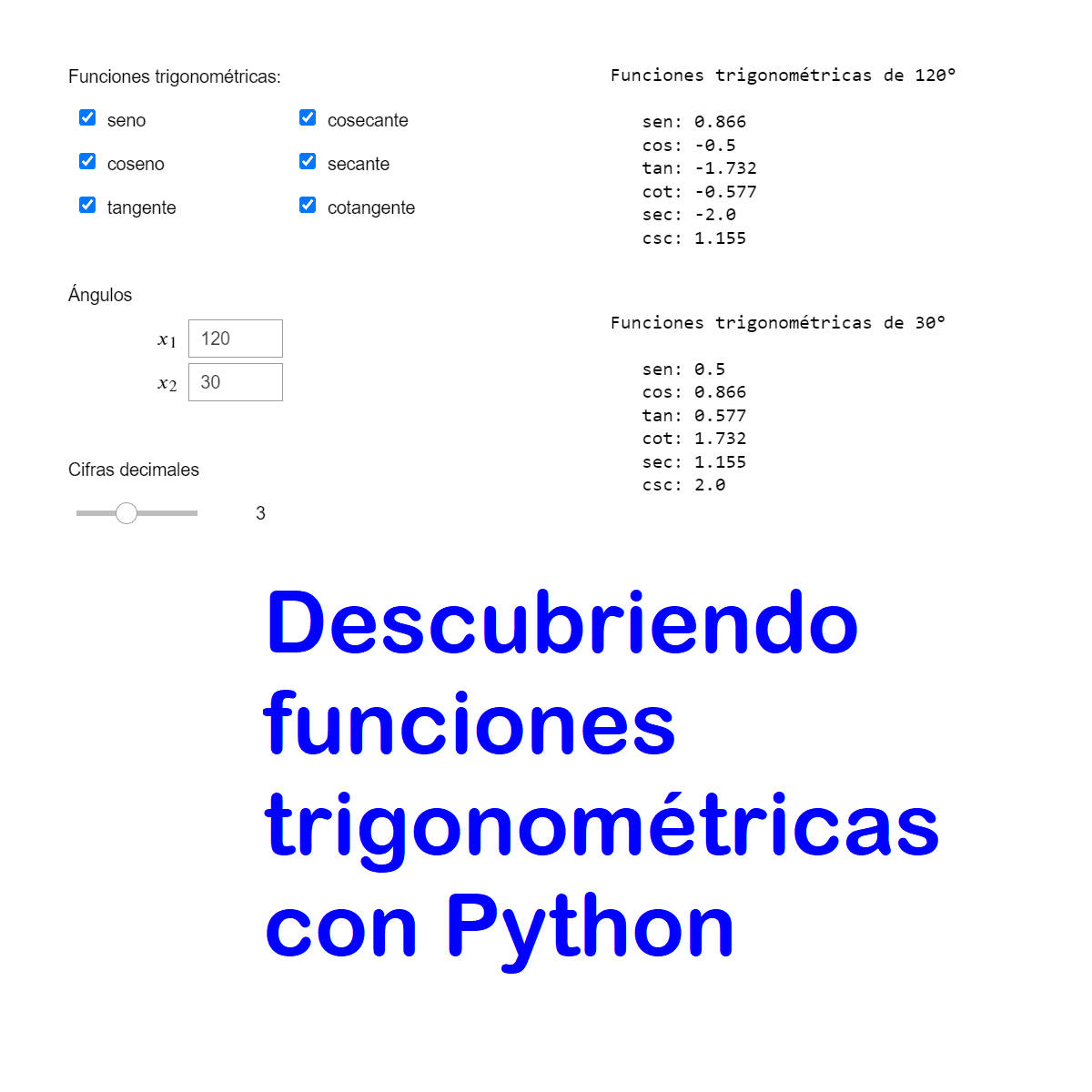
  En este proyecto guiado aprenderás a programar interfaces interactivas para explorar listas de funciones trigonométricas. El proyecto está dirigido a los docentes de la escuela secundaria con conocimientos básicos de programación de computadoras, tales como operaciones aritméticas y sentencias condicionales. Utilizarás el lenguaje Python 3.9 en Jupyter Notebook con el módulo math y la biblioteca ipywidgets para realizar tareas de análisis y de programación mediante guías en vídeos y en un cuaderno de prácticas que incluye enlaces a recursos informáticos y matemáticos. Los vídeos duran aproximadamente una hora y las tareas requieren dedicar alrededor de dos horas. Al finalizar el proyecto estarás en capacidad de programar interfaces básicas para ayudar a los estudiantes a descubrir propiedades y patrones matemáticos en las funciones trigonométricas.

  Nota: los proyectos guiados de la serie "Explorando/Tabulando/Graficando funciones ... con Python" contienen varias tareas similares para que puedan ser elegidos independientemente y solo los necesarios.

Enroll now

What's inside

Syllabus

Traffic lights

Read about what's good
what should give you pause
and possible dealbreakers
Este curso está diseñado para profesores de secundaria con conocimientos básicos de programación, centrándose en las aplicaciones para matemáticas escolares
Este curso se centra en las funciones trigonométricas, proporcionando una base sólida para los educadores de matemáticas
Utiliza Python 3.9, Jupyter Notebook, el módulo math y la biblioteca ipywidgets, herramientas ampliamente utilizadas para el análisis y la programación
Los videos guiados y el cuaderno de prácticas facilitan el aprendizaje y la implementación de las técnicas

Save this course

Create your own learning path. Save this course to your list so you can find it easily later.
Save

Reviews summary

Trigonometría y python para docentes

Según la descripción del curso, los alumnos aprenderán a crear interfaces interactivas con Python para explorar funciones trigonométricas. El curso está diseñado para docentes de secundaria con conocimientos básicos de programación, enfocándose en el uso de Jupyter Notebook e ipywidgets para aplicaciones didácticas. Se espera que los participantes adquieran la habilidad de desarrollar herramientas básicas que ayuden a sus estudiantes a descubrir propiedades matemáticas. Es un proyecto guiado que combina vídeos explicativos y cuadernos de práctica, ideal para integrar la tecnología en la enseñanza de las matemáticas.
Requiere Python básico y utiliza Jupyter Notebook e ipywidgets.
"Se necesita tener conocimientos básicos de programación en Python, como operaciones y condicionales."
"Se usa Python 3.9 en Jupyter Notebook con los módulos math e ipywidgets."
"La curva de aprendizaje para las herramientas parece adecuada si tengo las bases de Python."
Estructura en videos y cuadernos prácticos con duración definida.
"Me gusta que el proyecto se organiza en guías de vídeo y un cuaderno de prácticas."
"Aprecio la estimación de tiempo: una hora de vídeos y dos de tareas, lo que lo hace manejable."
"El formato de proyecto guiado es ideal para aprender haciendo."
Permite crear herramientas interactivas y aplicables en el aula.
"Podré programar interfaces básicas para ayudar a mis estudiantes a descubrir propiedades matemáticas."
"Busco aplicar Python para diseñar demostraciones prácticas para mis clases."
"Me entusiasma la posibilidad de crear material didáctico interactivo."
Especialmente útil para educadores de secundaria en matemáticas.
"Es un curso ideal para profesores de secundaria que buscan métodos innovadores de enseñanza."
"Me parece que este proyecto guiado ofrece herramientas muy relevantes para el aula de matemáticas."
"Pienso que este curso es perfecto para mi desarrollo profesional como educador."

Activities

Be better prepared before your course. Deepen your understanding during and after it. Supplement your coursework and achieve mastery of the topics covered in Descubriendo funciones trigonométricas con Python with these activities:
Revisar Álgebra
Practica habilidades algebraicas clave para apoyar el aprendizaje de funciones trigonométricas.
Show steps
  • Repasa ecuaciones lineales y cuadráticas.
  • Practica la factorización y expansión de expresiones algebraicas.
  • Repasa las propiedades de las funciones y las gráficas.
Crear un Cuaderno de Gráficas de Funciones Trigonométricas
Desarrolla habilidades de visualización y comprensión de las gráficas de funciones trigonométricas.
Show steps
  • Utiliza Jupyter Notebook para crear un cuaderno interactivo.
  • Importa las bibliotecas necesarias y define funciones trigonométricas.
  • Genera y grafica listas de puntos para varias funciones trigonométricas.
  • Ajusta los parámetros para explorar diferentes rangos y escalas.
  • Guarda el cuaderno para uso futuro y referencia.
Show all two activities

Career center

Learners who complete Descubriendo funciones trigonométricas con Python will develop knowledge and skills that may be useful to these careers:
Data Scientist
Data Scientists use the principles of math, statistics, computer science, and business to make sense of data. A background in Python programming is essential for this role since it aids in building machine learning models to predict future outcomes, analyze large data sets, and extract insights.
Software Engineer
Software engineers develop, maintain, and improve software applications and systems. The course helps build a solid foundation in the Python programming language, a key tool used by software engineers. Additionally, the course provides an understanding of mathematical concepts that are important for developing and optimizing software.
Financial Analyst
Financial Analysts use mathematical and statistical methods to analyze financial data and make investment recommendations. The course provides a solid foundation in Python programming, which is commonly used in financial modeling and data analysis. The course also introduces learners to probability and statistics.
Actuary
Actuaries use mathematical and statistical methods to assess risk and uncertainty in the insurance and finance industries. Python programming helps automate complex calculations. The course's focus on trigonometric functions will be beneficial for modeling risk and uncertainty.
Business Analyst
Business Analysts use data analysis and problem-solving skills to help businesses improve their performance. The course provides a foundation in Python programming, which is commonly used for data analysis. The course also develops problem-solving skills through interactive programming exercises.
Computer Programmer
Computer Programmers write and maintain computer code. The course provides a solid foundation in Python programming, which is a popular language for developing a wide range of applications. The course also teaches problem-solving skills and introduces mathematical concepts.
Data Analyst
Data Analysts collect, clean, and analyze data to extract insights. Python programming is a key tool for data cleaning and analysis. The course also provides an understanding of statistics and probability, which is essential for interpreting data.
Statistician
Statisticians use mathematical and statistical methods to collect, analyze, and interpret data. The course provides a foundation in math and statistics, which is essential for understanding and applying statistical methods. The course also introduces learners to Python programming, which is increasingly used in statistics.
Systems Analyst
Systems Analysts design and implement computer systems. The course provides a foundation in Python programming, which is often used for developing and maintaining software applications. The course also covers problem-solving skills and systems analysis techniques.
Quantitative Analyst
Quantitative Analysts use mathematical and statistical methods to analyze financial data and make investment decisions. The course provides a solid foundation in Python programming, which is widely used in quantitative finance. The course also develops problem-solving skills and introduces learners to probability and statistics.
Market Researcher
Market Researchers conduct research to understand market trends and consumer behavior. The course provides a foundation in Python programming, which helps in data collection and analysis. The course also introduces learners to probability and statistics, which are essential for conducting market research.
Software Developer
Software Developers design, develop, and maintain software applications. The course provides a solid foundation in Python programming, a popular language for software development. The course also teaches problem-solving skills and introduces mathematical concepts important for software development.
Business Intelligence Analyst
Business Intelligence Analysts use data analysis and visualization techniques to provide insights for business decision-making. The course provides a foundation in Python programming, which is commonly used for data analysis and visualization. The course also introduces learners to data mining and machine learning techniques.
Data Engineer
Data Engineers design and manage data systems. The course provides a foundation in Python programming, which is commonly used for data engineering. The course also introduces learners to database systems and cloud computing.
Machine Learning Engineer
Machine Learning Engineers design and implement machine learning models. The course provides a foundation in Python programming, which is widely used in machine learning. The course also introduces learners to probability, statistics, and linear algebra, which are essential for understanding and applying machine learning techniques.

Reading list

We've selected nine books that we think will supplement your learning. Use these to develop background knowledge, enrich your coursework, and gain a deeper understanding of the topics covered in Descubriendo funciones trigonométricas con Python.
Este libro es un texto clásico de trigonometría que proporciona una cobertura integral de los conceptos y aplicaciones de la trigonometría. Es adecuado para estudiantes que buscan una comprensión profunda de la trigonometría y su papel en diversas disciplinas.
Schaum's Outline of trigonometry that covers the core concepts of trigonometry, including trigonometric functions, identities, and equations. It is suitable for students who are looking for a comprehensive and problem-oriented introduction to trigonometry.
Este libro es un recurso completo para aprender funciones trigonométricas, que cubre temas como identidades, ecuaciones, gráficas y aplicaciones. Es adecuado para estudiantes que buscan desarrollar una base sólida en funciones trigonométricas y prepararse para cursos más avanzados.
Geometry and trigonometry textbook that covers a wide range of topics, including trigonometric functions, identities, and equations. It is suitable for students who are looking for a comprehensive review of geometry and trigonometry.
Widely used precalculus textbook that covers a range of topics, including trigonometry. It is suitable for students who are looking for a comprehensive review of precalculus topics, including trigonometry.
Concise precalculus textbook that covers a range of topics, including trigonometry. It is suitable for students who are looking for a concise and easy-to-understand introduction to trigonometry.
Trigonometry textbook for dummies that covers the core concepts of trigonometry, including trigonometric functions, identities, and equations. It is suitable for students who are looking for a friendly and easy-to-understand introduction to trigonometry.
Collection of essays on the history and applications of trigonometry. It is suitable for students who are interested in learning more about the history and development of trigonometry.

Share

Help others find this course page by sharing it with your friends and followers:

Similar courses

Similar courses are unavailable at this time. Please try again later.
Our mission

OpenCourser helps millions of learners each year. People visit us to learn workspace skills, ace their exams, and nurture their curiosity.

Our extensive catalog contains over 50,000 courses and twice as many books. Browse by search, by topic, or even by career interests. We'll match you to the right resources quickly.

Find this site helpful? Tell a friend about us.

Affiliate disclosure

We're supported by our community of learners. When you purchase or subscribe to courses and programs or purchase books, we may earn a commission from our partners.

Your purchases help us maintain our catalog and keep our servers humming without ads.

Thank you for supporting OpenCourser.

© 2016 - 2025 OpenCourser