We may earn an affiliate commission when you visit our partners.
Course image
LearnKartS

Welcome to the Kubernetes Fundamentals course!

The course aligns with the Certified Kubernetes Application Developer certification exam preparation.

This course will provide you with the skills and knowledge necessary to effectively use Kubernetes, thereby enhancing your ability to deploy, manage, and scale containerized applications in a professional setting.

The course is specifically designed for developers, software engineers, and DevOps professionals who work with Kubernetes and want to showcase their skills in deploying and managing applications

Read more

Welcome to the Kubernetes Fundamentals course!

The course aligns with the Certified Kubernetes Application Developer certification exam preparation.

This course will provide you with the skills and knowledge necessary to effectively use Kubernetes, thereby enhancing your ability to deploy, manage, and scale containerized applications in a professional setting.

The course is specifically designed for developers, software engineers, and DevOps professionals who work with Kubernetes and want to showcase their skills in deploying and managing applications

This course needs a good understanding of Linux and a comprehensive knowledge of Kubernetes and container concepts.

By the end of this course, you will be able to:

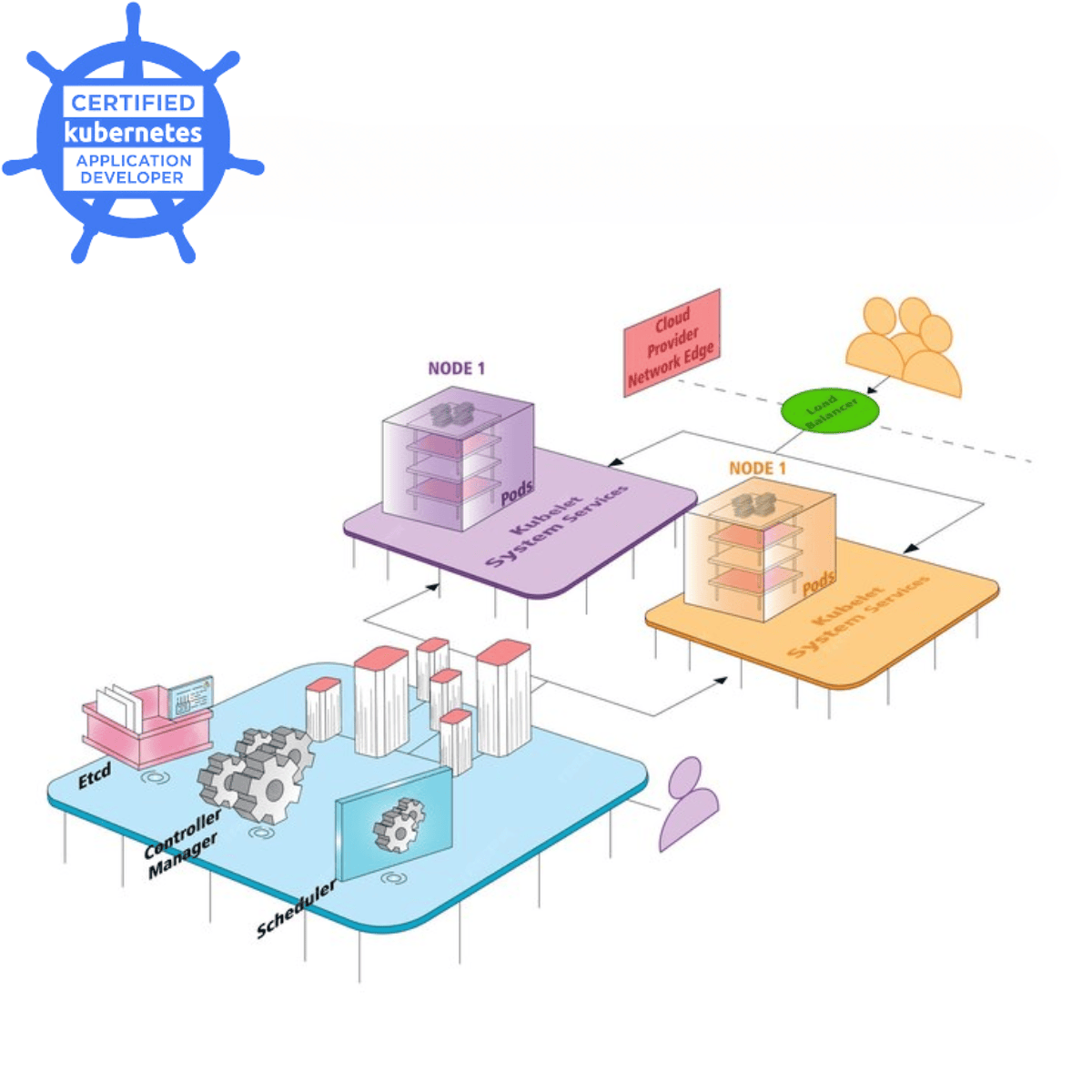
- Understand the core principles of Kubernetes architecture, including master and node components.

- Learn various deployment strategies using pods and containers, including YAML configuration and imperative management techniques.

- Explore Kubernetes networking concepts and services and configure networking policies.

- Gain proficiency in managing storage resources in Kubernetes environments.

This course contains engaging videos, readings, and knowledge checks for a high-quality learning experience.

Enroll now

What's inside

Syllabus

Kubernetes Fundamentals and Its Deployment
This module covers Kubernetes fundamentals, including its architecture and the relationship between Kubernetes and containers. By the end of this module, learners will grasp Kubernetes basics, facilitating efficient deployment and management of containerized applications through orchestration.
Read more

Traffic lights

Read about what's good
what should give you pause
and possible dealbreakers
The course prepares students for the Certified Kubernetes Application Developer certification exam
Suitable for developers, software engineers, and DevOps professionals with a background in Linux and Kubernetes
Introduces core Kubernetes concepts, including architecture, deployment strategies, networking, and storage management
Emphasizes hands-on learning through engaging videos, readings, and knowledge checks

Save this course

Create your own learning path. Save this course to your list so you can find it easily later.
Save

Reviews summary

Essential kubernetes foundation for professionals

According to learners, this course provides a solid and fundamental understanding of Kubernetes, proving particularly valuable for developers, software engineers, and DevOps professionals aiming for the Certified Kubernetes Application Developer (CKAD) exam. Students frequently highlight the clear and concise explanations of complex topics like networking and storage, along with highly beneficial hands-on labs. While the course delivers a strong foundation and its content is generally up-to-date, a minority of students found the pace inconsistent or felt it could offer deeper dives into advanced topics for those with significant prior experience.
Assumes foundational understanding of Linux and containers.
"It assumes you know Linux well, which is fair given the description."
"I found some parts a bit fast-paced, especially if you're not already familiar with container concepts."
"I appreciated that the course builds on existing container knowledge, making it a good fit for me."
Content remains relevant and current.
"Overall, a very good introduction to Kubernetes. The instructor explains well, and the content is up-to-date."
"The information itself is solid and relevant for professionals, reflecting current industry practices."
"I found the course content current and applicable to real-world scenarios, which is essential for rapidly evolving technologies like Kubernetes."
Practical labs enhance understanding.
"The labs are incredibly helpful and the explanations of complex topics like networking and storage are clear and concise."
"The hands-on coding and projects are the strongest part of the course for me, providing practical experience."
"I found the included hands-on exercises good, though more would have been great to further solidify concepts."
Concepts are explained clearly and concisely.
"The instructor explains well, and the content is up-to-date."
"The explanations of complex topics like networking and storage are clear and concise."
"As a developer transitioning to DevOps, this course was invaluable. It helped me grasp the core principles of Kubernetes architecture. The explanations were mostly clear..."
Excellent for certification exam readiness.
"Perfect course for CKAD preparation. I appreciated the structured approach and how each module builds upon the last."
"This course is fantastic for solidifying your understanding of Kubernetes concepts... It really prepares you for the CKAD exam. Highly recommend!"
"Absolutely fantastic for CKAD prep. The hands-on labs were great. Highly recommend this to anyone serious about Kubernetes."
Strong fundamentals, but limited advanced topics.
"While the fundamentals are covered, I felt the course was a bit surface-level in some areas."
"I found this course somewhat basic for someone who already knows containers... lacks depth in advanced topics."
"Useful if you're a complete beginner but for intermediate users, it's just a recap, potentially too basic at times."

Activities

Be better prepared before your course. Deepen your understanding during and after it. Supplement your coursework and achieve mastery of the topics covered in Kubernetes Fundamentals with these activities:
Kubernetes Basics Crash Course
Reinforce foundational knowledge of Kubernetes concepts and architecture prior to course commencement.
Browse courses on Kubernetes Concepts
Show steps
  • Review Kubernetes core components, including master and worker nodes.
  • Understand the role of pods, containers, and container orchestration.
Kubernetes: Up and Running
Gain in-depth knowledge of Kubernetes architecture, concepts, and best practices from industry experts.
Show steps
  • Read through the book to grasp the fundamental principles of Kubernetes.
  • Refer to specific sections for further clarification on topics covered in the course.
Deploying Containers with YAML and Imperative Commands
Enhance familiarity with practical deployment techniques using YAML and imperative commands.
Browse courses on Container Deployment
Show steps
  • Create a simple Kubernetes deployment using YAML configuration.
  • Modify existing deployments using imperative commands.
  • Explore different deployment options, such as rolling updates and canary releases.
Four other activities
Expand to see all activities and additional details
Show all seven activities
Kubernetes Hands-on Lab: Deploying a Multi-Tier Application
Apply practical skills by deploying a complex multi-tier application using Kubernetes.
Browse courses on Kubernetes Deployment
Show steps
  • Identify a suitable multi-tier application for deployment.
  • Follow a guided tutorial to deploy the application using Kubernetes.
  • Monitor and troubleshoot the deployment to ensure seamless operation.
Kubernetes Networking Study Group
Engage with peers to delve deeper into networking concepts, services, and policies within Kubernetes.
Show steps
  • Join a study group focused on Kubernetes networking.
  • Participate in discussions and knowledge-sharing sessions.
  • Collaborate on projects involving Kubernetes networking configuration.
Design and Implement a Storage Strategy
Demonstrate proficiency in designing and implementing a comprehensive storage strategy for containerized applications.
Show steps
  • Research different storage options available in Kubernetes, such as persistent volumes, storage classes, and dynamic provisioning.
  • Design a storage strategy that meets the specific requirements of the application.
  • Implement the storage strategy by creating the necessary Kubernetes objects.
  • Monitor and maintain the storage solution to ensure optimal performance and availability.
Contribute to Open Source Kubernetes Projects
Deepen understanding by actively participating in the development and maintenance of Kubernetes open source projects.
Browse courses on Kubernetes
Show steps
  • Identify open source Kubernetes projects that align with interests.
  • Contribute to bug fixes, feature enhancements, or documentation.
  • Network with other Kubernetes enthusiasts and experts.

Career center

Learners who complete Kubernetes Fundamentals will develop knowledge and skills that may be useful to these careers:

Reading list

We've selected 50 books that we think will supplement your learning. Use these to develop background knowledge, enrich your coursework, and gain a deeper understanding of the topics covered in Kubernetes Fundamentals.
Authored by Kubernetes co-founders, this canonical text delivers the definitive mental model for container orchestration, pod scheduling, services, and declarative deployment lifecycles.
Provides comprehensive guidance on continuous delivery, covering the entire software delivery pipeline from development to deployment. It emphasizes best practices for automating build, test, and deployment processes, enabling faster and more reliable software releases.
Systematizes reusable cloud-native design patterns, analyzing sidecar injection, adapter containers, leader election, and distributed configuration across production clusters.
A highly regarded book that explores the challenges of designing data-intensive systems, covering various data storage and processing technologies. It provides a fundamental understanding of the trade-offs and principles involved in building modern data systems. is considered a must-read for software engineers and architects.
Addresses high-stakes enterprise operational challenges, detailing multi-cluster networking, ingress controller architecture, cluster autoscaling, and disaster recovery strategies.
Explains core cluster architecture with remarkable pedagogical clarity, demystifying etcd consensus, API server mechanics, and runtime security for systems engineers.
Guides systems developers through extending the Kubernetes control plane, focusing on client-go libraries, custom resource definitions (CRDs), and controller reconciliation loops.
Provides a comprehensive guide to using Pods in Kubernetes, covering topics such as creating, managing, and troubleshooting Pods. It is an excellent resource for anyone who wants to learn more about Pods and how to use them effectively.
Presents high-availability architectural blueprints for distributed cloud systems, covering cluster topology, horizontal autoscaling, load shedding, and resilience engineering.
A classic in network security, this book provides a foundational understanding of cryptographic principles and secure communication protocols. It delves into the theoretical underpinnings of network security, essential for anyone specializing in this area.
Tackles operational infrastructure for training and serving machine learning workloads, exploring GPU scheduling, orchestrator optimization, and distributed tensor pipelines.
A practical guide focusing on data backup and recovery strategies for systems administrators. It covers various backup applications and the implementation of modern backup architectures. is highly relevant for IT professionals responsible for data protection.
Demystifies the Operator SDK framework, teaching site reliability engineers how to encapsulate human operational knowledge into automated, self-healing Go controllers.
Delves into contemporary networking topics such as Software-Defined Networking (SDN), Network Functions Virtualization (NFV), Internet of Things (IoT), and cloud networking. It provides a good overview of the evolving landscape of modern networks.
A practical guide for storage administrators on building and managing large data centers using SANs and NAS. It covers the similarities and differences between these technologies and discusses backup and recovery in these environments. is particularly useful for professionals and advanced undergraduate students interested in storage administration.
Focuses on the critical aspects of data protection, including backup, recovery, replication, and business continuity. It covers both traditional and modern approaches to ensuring data availability in various environments, including the cloud. This book is highly relevant for IT professionals and those involved in designing and implementing data protection strategies.
Details modern GitOps deployment pipelines, examining declarative configuration management, continuous cluster state synchronization, and automated blue-green rollouts.
This practical guide focuses on real-world networking scenarios and configurations, particularly relevant for those working with Cisco equipment. It bridges the gap between theoretical knowledge and practical application, making it highly useful for network administrators and engineers.
Focuses on cryptographic key protection and sensitive configuration management, detailing Vault integrations, external secrets operators, and envelope encryption workflows.
A hands-on guide to network security monitoring, this book covers the tools and techniques used to collect, detect, and analyze network data for security purposes. It complements theoretical knowledge with practical application.
Examines the convergence of cloud, virtualization, and data storage networking. It provides a practical guide to leveraging these technologies for efficient information services delivery. This book is relevant for professionals and graduate students focusing on modern data center architectures.
Offers a comprehensive overview of various storage networking technologies, including SAN, NAS, iSCSI, and Fibre Channel. It covers both the basics and their applications, making it a valuable reference for understanding the diverse landscape of storage networks. This book is suitable for advanced undergraduate students, graduate students, and professionals.
Furnishes an encyclopedic technical reference covering cluster provisioning, service mesh deployment, storage class drivers, and enterprise observability stacks.
Provides fundamental coverage of software-defined data infrastructures, including cloud, converged, and virtual storage. It offers insights into the technologies and techniques for modern storage environments. This book is relevant for professionals and advanced students interested in the evolution of storage infrastructure.
Demonstrates declarative infrastructure composition using Crossplane, allowing platform teams to manage cloud provider resources directly through standard Kubernetes manifests.
Investigates defense-in-depth container security, exploring kernel namespace isolation, seccomp profiles, admission controllers, and runtime vulnerability scanning.
Guide to using Pods in Kubernetes for operators. It covers topics such as creating, managing, and scaling Pods. It good resource for operators who want to use Pods in Kubernetes.
Guide to using Pods in Kubernetes for data scientists. It covers topics such as creating, managing, and scaling Pods. It good resource for data scientists who want to use Pods in Kubernetes.
Guide to using Pods in Kubernetes for machine learning engineers. It covers topics such as creating, managing, and scaling Pods. It good resource for machine learning engineers who want to use Pods in Kubernetes.
Guide to using Pods in Kubernetes for network engineers. It covers topics such as creating, managing, and scaling Pods. It good resource for network engineers who want to use Pods in Kubernetes.
While not solely focused on deployments, this book provides a broader perspective on DevOps culture and practices, including deployment automation and continuous delivery. It emphasizes the importance of collaboration between development and operations teams for successful software delivery.
Delves into the technical aspects of storage systems, covering organization, performance, coding, and reliability, including RAID and flash memories. It provides a deep understanding of the underlying principles of modern storage. This book is most suitable for graduate students, researchers, and IT professionals with a strong technical background.
While focused on databases, this book provides comprehensive coverage of data storage principles, modeling, and systems. It bridges the gap between theoretical concepts and practical application, making it valuable for understanding the storage underpinnings of data management. is suitable for undergraduate and graduate students.
Provides pragmatic troubleshooting recipes for cluster engineers, solving real-world networking outages, persistent volume binding failures, and OOMKilled worker nodes.
A comprehensive guide diving into the design and implementation of file systems, using the Be File System as a detailed example. is valuable for those seeking an in-depth understanding of file system internals. It is more suitable for advanced undergraduate students, graduate students, and professionals.
Bridges network perimeter security and cluster ingress, demonstrating how reverse tunneling and outbound-only mTLS connections eliminate open inbound firewall attack surfaces.
Connects container orchestration with developer application stacks, guiding engineers through containerizing microservices, wiring Terraform provisioning, and staging clusters.
Shares Google's experience in site reliability engineering (SRE), covering topics such as incident management, monitoring, and deployment strategies. Its focus on large-scale systems and resilient infrastructure provides valuable insights for deployment engineers.
Focuses specifically on the security and privacy risks associated with cloud storage. It provides a practical guide and a checklist for evaluating security considerations when using cloud storage. This book is essential for professionals and students interested in cloud security.
A popular study guide for the CompTIA Network+ certification, this book covers a wide range of networking fundamentals. It is an excellent resource for beginners and those preparing for entry-level networking roles, providing a structured approach to learning key concepts.
While a general operating systems textbook, it includes essential chapters on storage management, file systems, and disk management. It provides foundational knowledge on how operating systems interact with and manage storage hardware. classic textbook for undergraduate students in computer science.
Explains the basic concepts of computer storage, including fundamental features, functionalities, and how servers access storage systems. It covers different types of storage systems, components, networking, performance, fault tolerance, and management. It good resource for beginners to grasp the foundational aspects of storage.
Provides a foundational understanding of Storage Area Networks (SANs), covering topologies, protocols, and implementation techniques. It's a good resource for those new to SANs and looking to grasp the core concepts. This book is suitable for undergraduate students and IT professionals entering the storage networking field.
A captivating true story about tracking a computer hacker, this book provides a real-world perspective on network security incidents and the importance of network monitoring and analysis. It's an engaging read that highlights the practical side of network security.

Share

Help others find this course page by sharing it with your friends and followers:

Similar courses

Here are nine courses similar to Kubernetes Fundamentals.
Container and Container Orchestration Fundamentals
Most relevant
App Dev: Deploying the Application into Kubernetes Engine...
Most relevant
Kubernetes for the Absolute Beginners - Hands-On
Most relevant
Advanced Kubernetes Deployment Strategies and Networking
Most relevant
Exam Prep CKA: Certified Kubernetes Administrator
Most relevant
Introduction to OpenStack and Kubernetes Orchestrators
Most relevant
Pod Management with Kubernetes: Run containerized...
Most relevant
Architecting with Google Kubernetes Engine: Workloads
Most relevant
Fundamentals of Kubernetes Deployment
Most relevant

Coursera Buyer Protection & Guarantee

Verified partner policies & purchase protections

Accredited University Partner
Free Trial & Audit

7-Day Free Trial & Free Audit

7-day free trial on monthly Coursera Plus subscriptions; free audit option available on most individual courses to explore video lectures and readings at no charge.

Return & Refund Policy

14-Day Refund Guarantee

14-day refund window on annual Coursera Plus subscriptions and single-course purchases prior to certificate issuance. Monthly subscriptions do not offer refunds once billed.

Buyer Protections

Verified Academic & Industry Partner

Accredited university and industry certifications (e.g. Stanford, Google, IBM, Yale), secure SSL payment processing, and verifiable digital certificate links.

Key Purchase Protections
14-day refund window on annual Coursera Plus and single courses
7-day free trial on monthly Coursera Plus subscriptions
Free course audit option for lectures and readings
Verified certificates from top universities & companies
OpenCourser Verified Partner Policy details last reviewed: 2026-10-22
Our mission

OpenCourser helps millions of learners each year. People visit us to learn workspace skills, ace their exams, and nurture their curiosity.

Our extensive catalog contains over 50,000 courses and twice as many books. Browse by search, by topic, or even by career interests. We'll match you to the right resources quickly.

Find this site helpful? Tell a friend about us.

Affiliate disclosure

We're supported by our community of learners. When you purchase or subscribe to courses and programs or purchase books, we may earn a commission from our partners.

Your purchases help us maintain our catalog and keep our servers humming without ads.

Thank you for supporting OpenCourser.

© 2016 - 2025 OpenCourser