February 23, 2025
Updated July 15, 2025
18 minute read
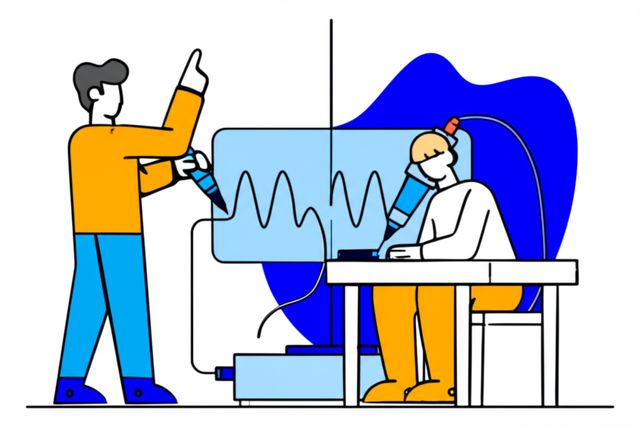
An Introduction to Ultrasonic Testing
Ultrasonic Testing (UT) is a powerful and versatile method of non-destructive testing (NDT) that uses high-frequency sound waves to examine the internal structure of materials. Much like a medical ultrasound allows doctors to see inside the human body without surgery, industrial UT provides a way to detect hidden flaws, measure thickness, and characterize material properties without cutting into or damaging the component being inspected. This capability is crucial for ensuring the safety, reliability, and integrity of critical components across a vast range of industries, from the planes we fly in to the bridges we cross.
Working in Ultrasonic Testing can be a deeply engaging career. It combines hands-on work with sophisticated technology and a deep understanding of physics and materials science. Technicians and engineers in this field often feel a sense of purpose, knowing their meticulous work prevents catastrophic failures and protects lives. The role is part detective, part scientist, as you use sound waves to uncover clues about what lies beneath the surface of a material. Furthermore, the demand for skilled UT professionals spans nearly every major industrial sector, offering diverse work environments and the opportunity to be at the forefront of quality control and asset integrity management.
Introduction to Non-Destructive Testing (NDT) and Ultrasonic Testing (UT)
Before diving deep into the world of ultrasonic waves, it is helpful to understand the broader field in which it resides: Non-Destructive Testing. This larger context helps explain why UT is such a critical and widely adopted technology.
nnnv6u|
Find a path to becoming a Ultrasonic Testing. Learn more at:
OpenCourser.com/topic/nnnv6u/ultrasonic
Reading list
We've selected 14 books
that we think will supplement your
learning. Use these to
develop background knowledge, enrich your coursework, and gain a
deeper understanding of the topics covered in
Ultrasonic Testing.
Provides a detailed look at automated ultrasonic testing specifically for pipeline girth welds, a critical industrial application. It covers the techniques, procedures, and technology used in this specialized area. It is highly valuable for professionals working in the pipeline industry and those interested in automated UT systems.
Dedicated to the Time of Flight Diffraction (TOFD) technique, this book offers an in-depth exploration of its principles and applications in ultrasonic testing. TOFD is an advanced sizing technique, making this book relevant for those deepening their UT knowledge. It's a valuable resource for practitioners and researchers utilizing or studying TOFD.
Designed to meet ISO 9712 certification requirements, this book offers a practical approach to industrial ultrasonic inspection. It is excellent for gaining a broad understanding of UT principles and techniques relevant to field applications. It serves as a valuable textbook for students and technicians preparing for certification and provides practical knowledge for working professionals.
Delves into the theoretical and mathematical foundations of ultrasonic NDT. It is suitable for graduate students, researchers, and professionals seeking a deep understanding of the physics behind ultrasonic wave propagation and interaction with materials. It provides the theoretical basis necessary for developing advanced UT techniques and interpreting complex data.
Delves into nonlinear ultrasonic and vibro-acoustical techniques, representing a more advanced and research-oriented area of NDE. It is suitable for graduate students and researchers exploring advanced methods for material characterization and defect detection using nonlinear acoustics.
Considered a foundational text in the field of ultrasonic testing. provides a comprehensive overview of the physical principles and methods of UT, suitable for gaining a broad and deep understanding. While older, its fundamental concepts remain highly relevant, making it valuable for historical context and foundational knowledge. It's often referenced in academic and professional settings.
A comprehensive handbook covering all major NDE methods, with a substantial part dedicated to ultrasonic testing. It serves as an excellent reference for gaining a broad understanding of NDE and provides detailed information on UT techniques, equipment, and applications. Useful for professionals and students needing a single resource for various NDT methods.
Addresses the critical topic of Probability of Detection (POD) in NDT, which is highly relevant to advanced ultrasonic testing applications and procedure qualification. Understanding POD is essential for assessing the reliability of UT inspections. Suitable for graduate students and professionals involved in developing or validating NDT procedures.
This comprehensive textbook covers various NDE methods, with a significant section dedicated to ultrasonic testing. It provides a good overview of UT within the broader context of NDE, discussing theory, techniques, and applications. It's a useful resource for students and professionals seeking a broad understanding of NDE, with sufficient depth on UT principles and applications.
Covers the basic principles and practices of ultrasonic testing, from the theory of wave propagation to various testing techniques and equipment. It is suitable for undergraduate students and those new to the field seeking a solid introduction. It provides a good foundation for understanding how UT works and its practical applications.
Covers the principles, procedures, and applications of various NDT techniques, including a significant section on ultrasonic testing. It offers a practical perspective on NDT, making it valuable for students and professionals seeking a broad understanding of how UT fits within the overall NDT landscape and its real-world applications.
While not solely focused on NDT, this book provides a strong foundation in the principles of physical acoustics, which are fundamental to understanding ultrasonic testing. It is beneficial for students and researchers who need a deeper theoretical understanding of wave propagation and interaction with materials at a physics level.
While covering a range of materials characterization techniques, this book provides context for how ultrasonic testing (as a macroscopic technique) complements other methods for understanding material properties and defects. It helps broaden the understanding of how UT fits into the larger field of materials science and characterization.
For more information about how these books relate to this course, visit:
OpenCourser.com/topic/nnnv6u/ultrasonic

 Save
Save


