We may earn an affiliate commission when you visit our partners.
Course image
Henrique Branco

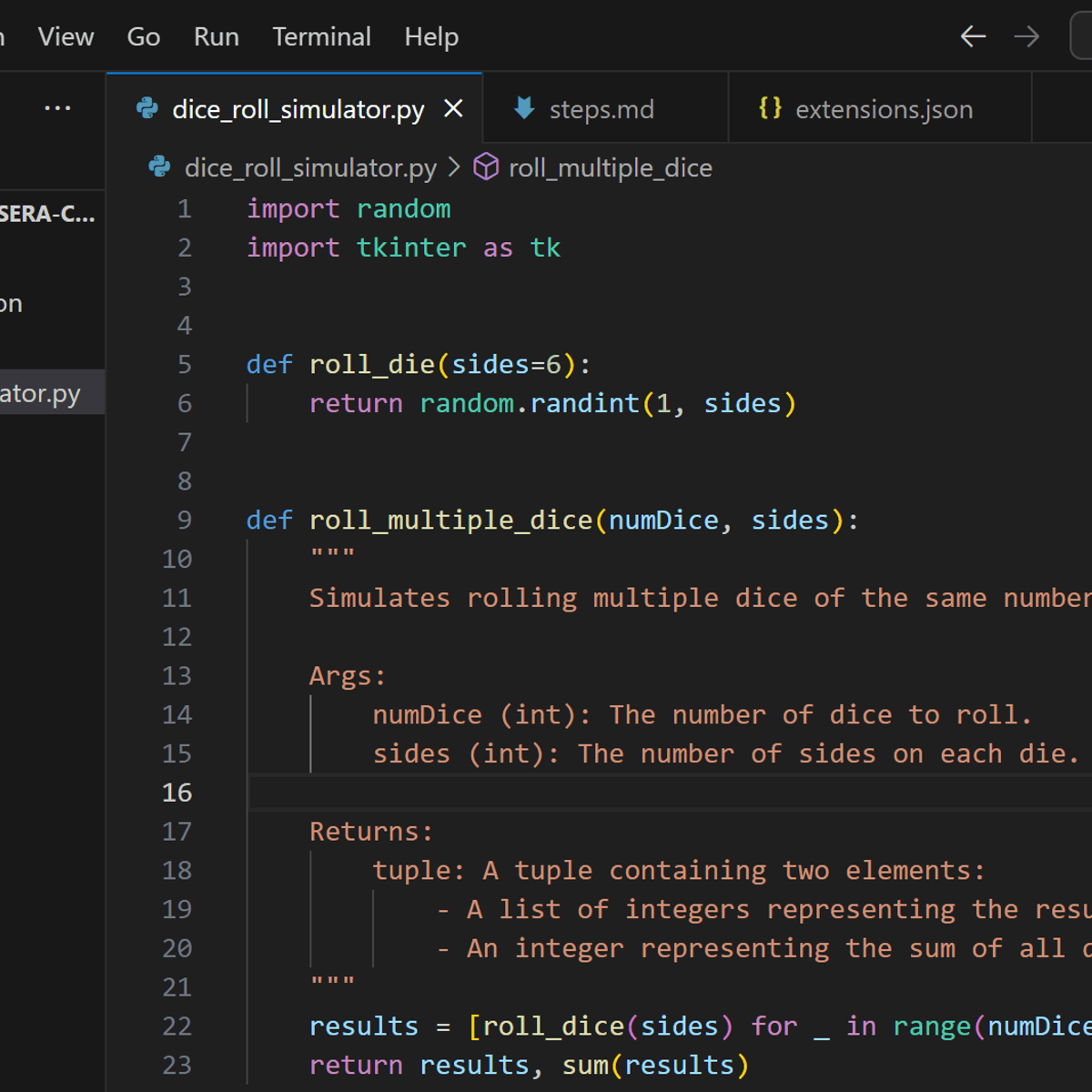
Upgrade your development workflow and start writing code like a professional! This project aims to empower software developers to leverage advanced features within Visual Studio Code to enhance their development workflow.

Throughout this project-based course, participants will explore various advanced functionalities of Visual Studio Code, including advanced code navigation, customization of settings and keybindings, and the utilization of powerful extensions for debugging, version control, and language support.

Read more

Upgrade your development workflow and start writing code like a professional! This project aims to empower software developers to leverage advanced features within Visual Studio Code to enhance their development workflow.

Throughout this project-based course, participants will explore various advanced functionalities of Visual Studio Code, including advanced code navigation, customization of settings and keybindings, and the utilization of powerful extensions for debugging, version control, and language support.

Participants will embark on a journey to create a customized development environment tailored to their specific workflow needs. Through real-world coding scenarios, debugging sessions, and version control tasks, participants will gain hands-on experience optimizing their development process using Visual Studio Code.

This project stands out for its comprehensive exploration of Visual Studio Code's advanced capabilities, offering developers the opportunity to significantly boost their productivity and efficiency. Prior experience with programming concepts and familiarity with Visual Studio Code are recommended for success in this project.

Enroll now

What's inside

Syllabus

Traffic lights

Read about what's good
what should give you pause
and possible dealbreakers
Develops advanced Visual Studio Code skills, which are core tools for software developers
Core audience includes experienced programmers familiar with Visual Studio Code
Builds proficiency in writing code and optimizing development workflow
Requires familiarity with programming concepts and Visual Studio Code

Save this course

Create your own learning path. Save this course to your list so you can find it easily later.
Save

Reviews summary

Vscode for developers: professional environment setup

According to learners, "VSCode for Developers: Set up a professional environment" is a highly effective course for developers aiming to master advanced VSCode features. Students praise its practical insights, clear explanations, and hands-on approach, which help them streamline their workflow and significantly boost productivity. The course covers key areas like customizations, extensions, and debugging, proving valuable for those looking to tailor their environment. While not for absolute beginners, it's considered a solid investment by intermediate to seasoned users, despite one older, outlier review suggesting a lack of depth.
Content is well-structured with precise and relevant examples.
"The instructor explains complex topics clearly and concisely, making it easy to follow along."
"The explanations are precise, and the examples are relevant."
"The content is current and relevant. The instructor is knowledgeable."
"The practical examples and real-world scenarios make the learning experience engaging and directly applicable. Top-notch content!"
Explores advanced VSCode capabilities and tailoring environment.
"An excellent course for intermediate to advanced VSCode users. It dives deep into customizations and extensions, showing how to truly tailor my environment."
"As a seasoned developer, this course surprised me. It covers advanced topics without being overwhelming and even introduced me to a few extensions."
"The way they explain keybindings and snippets truly transformed my coding speed. I also appreciated the coverage of Git integration within VSCode."
"I appreciated the comprehensive exploration of Visual Studio Code's advanced capabilities to significantly boost my productivity."
Helps developers optimize workflow and boost efficiency.
"This course is exceptionally well-structured and provides practical insights into optimizing VSCode for a professional development workflow."
"I learned so many new tips and tricks that I didn't even know existed. The hands-on exercises were particularly helpful."
"I found this course incredibly helpful for streamlining my workflow."
"The course provided clear, actionable steps to enhance my VSCode environment. I liked the practical sections for my work."
Best suited for intermediate to seasoned developers.
"Not for absolute beginners though."
"It covers a lot of ground quickly, which is great for experienced users but might be a bit fast for total newcomers."
"I would recommend prior experience with programming concepts and familiarity with Visual Studio Code for success."
Some found content basic, others found it advanced.
"Honestly, I found this course to be a complete waste of time. It feels like a quick run-through of basic VSCode features, nothing advanced."
"I already knew most of this from watching free YouTube tutorials. Very disappointed, expected much more depth for a 'professional' environment course."
"As a seasoned developer, this course surprised me. It covers advanced topics without being overwhelming and even introduced me to a few extensions I didn't know about."
"I consider this an excellent course for intermediate to advanced VSCode users, as it dives deep into customizations and extensions."

Activities

Be better prepared before your course. Deepen your understanding during and after it. Supplement your coursework and achieve mastery of the topics covered in VSCode for Developers: Set up a professional environment with these activities:
Connect with Experienced Developers
Enhance your learning by seeking guidance and support from experienced Visual Studio Code developers.
Browse courses on Mentorship
Show steps
  • Identify Potential Mentors
  • Reach Out and Introduce Yourself
  • Schedule Regular Check-Ins
Review Visual Studio Code Introduction
Refresh your basics and become comfortable with the Visual Studio Code environment.
Show steps
  • Explore Visual Studio Code Interface and Features
  • Configure User Settings and Preferences
  • Install Essential Extensions
Follow Video Tutorials on VS Code Extensions
Enhance your VS Code knowledge by following guided tutorials on the latest and most useful extensions.
Show steps
  • Search for video tutorials on specific VS Code extensions
  • Watch the tutorials and take notes
  • Install and configure the extensions in your VS Code environment
  • Experiment with the extensions and explore their features
  • Share your insights or ask questions in online communities
12 other activities
Expand to see all activities and additional details
Show all 15 activities
Organize and Review Course Materials
Enhance your understanding by compiling and reviewing all course materials in an organized manner.
Show steps
  • Gather and organize lecture notes, slides, and assignments
  • Review materials regularly to reinforce concepts
  • Identify areas that require further clarification
  • Create summaries or mind maps to connect and retain information
  • Utilize active recall techniques to test your understanding
Peer Discussion: Share Development Best Practices
Engage with fellow developers to exchange ideas and learn from their experiences in Visual Studio Code.
Browse courses on Collaboration
Show steps
  • Join a Peer Discussion Group
  • Prepare Questions and Insights to Share
  • Actively Participate in Discussions
Read Visual Studio Code User Manual
Understand core VS Code features and best practices from the official user manual.
Show steps
  • Download and install Visual Studio Code
  • Explore the VS Code interface and basic features
  • Configure settings and keyboard shortcuts
  • Learn about code navigation and debugging tools
  • Review extensions and marketplace
Guided Tutorial: Mastering Advanced Editor Features
Enhance your development workflow by exploring advanced features in Visual Studio Code's editor.
Browse courses on Code Navigation
Show steps
  • Utilize Code Navigation Tricks
  • Automate Coding with Emmet and Snippets
  • Organize Your Projects Effectively
Create a Personal Development Environment
Build a tailored development setup optimized for your specific preferences and project requirements.
Browse courses on Development Environment
Show steps
  • Identify your development needs and goals
  • Research and select relevant extensions
  • Configure settings and keybindings
  • Integrate version control and debugging tools
  • Test and refine your development environment
Coding Challenges: Practice Debugging Techniques
Sharpen your debugging skills by working through coding challenges.
Browse courses on Debugging
Show steps
  • Analyze Error Messages and Trace Code Execution
  • Set Breakpoints and Step Through Code
  • Identify and Resolve Common Bugs
Complete VS Code Code Challenges
Test your understanding of VS Code features by solving practical coding challenges.
Browse courses on Coding Exercises
Show steps
  • Find an online platform or repository with VS Code code challenges
  • Select a challenge that aligns with your skill level
  • Solve the challenge using VS Code
  • Review your solution and identify areas for improvement
  • Repeat the process with different challenges
Attend a VS Code Workshop
Accelerate your learning by attending a workshop led by experienced VS Code professionals.
Browse courses on Skill Development
Show steps
  • Research and find relevant VS Code workshops
  • Register for a workshop that aligns with your goals
  • Attend the workshop and actively participate
  • Network with other attendees and speakers
  • Apply what you learned to your own projects
Attend Workshop: Advanced Extension Development
Expand your knowledge and skills by attending a workshop on advanced extension development for Visual Studio Code.
Show steps
  • Research and Identify a Suitable Workshop
  • Register and Prepare for Participation
  • Attend the Workshop and Engage Actively
Project: Build a Customized Development Environment
Tailor Visual Studio Code to your specific workflow needs by creating your own customized development environment.
Browse courses on Customization
Show steps
  • Define Your Customization Goals
  • Configure Settings, Keybindings, and Extensions
  • Test and Iterate to Optimize Your Environment
Write a Blog Post on Advanced VS Code Features
Solidify your understanding by sharing your knowledge on advanced VS Code features in a blog post.
Show steps
  • Choose a specific advanced feature to focus on
  • Research and gather information
  • Write a clear and concise blog post
  • Edit, proofread, and publish your post
  • Promote and share your blog post
Contribute to an Open-Source VS Code Extension
Deepen your understanding of VS Code internals by contributing to an open-source extension.
Browse courses on Community Involvement
Show steps
  • Find a suitable open-source VS Code extension to contribute to
  • Review the extension's codebase and identify potential contributions
  • Reach out to the extension maintainers and propose your ideas
  • Implement and test your changes
  • Submit your code for review and merge

Career center

Learners who complete VSCode for Developers: Set up a professional environment will develop knowledge and skills that may be useful to these careers:

Reading list

We've selected 44 books that we think will supplement your learning. Use these to develop background knowledge, enrich your coursework, and gain a deeper understanding of the topics covered in VSCode for Developers: Set up a professional environment.
This foundational book, often referred to as the 'Gang of Four' book, introduces essential design patterns that are crucial for creating flexible and extensible software. Understanding these patterns provides a common vocabulary and proven solutions for building modular and adaptable systems. It cornerstone text for anyone serious about software design and extensibility.
Provides an in-depth look at Visual Studio Code, including how to use it to build web applications, mobile apps, and data science projects.
This is the seminal book on refactoring, a disciplined technique for improving the internal structure of code without changing its external behavior. Understanding refactoring is crucial for navigating and modifying complex codebases effectively. fundamental resource for anyone serious about code quality and navigation.
Using the engaging Head First approach, this book makes learning design patterns accessible and enjoyable. It covers the same core patterns as the 'Gang of Four' book but with a more visual and narrative style, making it an excellent resource for those new to design patterns and the concepts of building extensible software.
Provides a comprehensive overview of DevOps and how to implement it in your organization. It is helpful for understanding the principles and practices of DevOps and how they can be used to improve the software development process.
Comprehensive guide for teachers who want to implement customized learning in their classrooms. It provides practical strategies and resources that can be used to create and deliver customized learning experiences for students.
Offers practical advice on a wide range of software development topics, including writing maintainable code, refactoring, and effectively using tools. Its emphasis on pragmatic practices directly contributes to creating code that is easier to navigate and understand. It's considered a must-read for developers at all stages.
Focuses on writing code that is readable, understandable, and maintainable. While not strictly about navigation tools, the principles of writing clean code directly impact how easily a developer can navigate and comprehend a codebase. It's a highly recommended book for improving code quality.
Microservices architecture common approach for building scalable and extensible systems. provides a comprehensive guide to designing and implementing microservices, covering topics like service decomposition, integration patterns, and testing, all of which are relevant to creating extensible systems through well-defined interfaces and independent components.
A classic in the field of software architecture, this book covers fundamental concepts, quality attributes, and architectural patterns. It provides a solid understanding of how to design software systems that are not only functional but also maintainable, evolvable, and extensible.
Introduces Domain-Driven Design (DDD), an approach to software development that focuses on modeling the business domain. DDD principles help in creating software that is aligned with business needs and is more maintainable and extensible as the domain evolves. It is particularly useful for complex systems where a deep understanding of the problem domain is crucial for effective design.
An updated edition of the highly regarded Code Complete, this book continues to offer invaluable guidance on software construction practices, including design, coding, and debugging. Its comprehensive nature makes it a strong reference for writing navigable and understandable code.
Comprehensive catalog of patterns for integrating enterprise applications. Understanding these patterns is crucial when building systems that need to communicate and exchange data, which is often a key aspect of creating extensions and integrations across different software components and services.
Provides a comprehensive overview of modern software engineering practices, including DevOps. It is helpful for understanding the principles and practices of DevOps and how to implement them in your organization.
While not solely focused on extensions, this book provides practical advice on writing flexible, adaptable, and maintainable code. Its principles, such as DRY (Don't Repeat Yourself) and writing flexible code, are highly relevant to creating systems that can be easily extended and integrated with. This widely recommended book for any software developer seeking to improve their craft.
Provides a comprehensive overview of concurrency in C++. It is helpful for understanding the principles and practices of concurrency in C++ and how they can be applied to improve the development workflow for concurrent C++ projects.
Provides insights into the software engineering practices at Google, covering topics like testing, dependency management, and development processes. Understanding these large-scale practices provides valuable context for navigating and contributing to large, complex codebases typical in professional environments.
Delves into Protocol-Oriented Programming (POP) in Swift, a paradigm that heavily utilizes protocols and extensions to achieve flexibility and code reuse. It is directly relevant to understanding how extensions are used within the Swift language for adding functionality to existing types and implementing behaviors.
While focused on data systems, this book provides crucial insights into building scalable and maintainable applications, which often require effective extension points and integration strategies. Understanding the principles of designing robust data systems is valuable for building extensible applications that interact with data.
Focuses on one particular aspect of development workflow, specifically on continuous delivery and how it leads to reliable software releases. It provides a comprehensive overview of the topic and is helpful for understanding the principles and practices of continuous delivery.
Provides a detailed look at how Google runs its production systems. It is helpful for understanding the principles and practices of site reliability engineering and how they can be applied to improve the reliability of your own systems.
Provides a comprehensive overview of continuous integration and how to implement it in your organization. It is helpful for understanding the principles and practices of continuous integration and how they can be used to improve the quality of your software.
Provides a software architect's perspective on DevOps. It is helpful for understanding the principles and practices of DevOps and how they can be applied to improve the software development process.
Provides a comprehensive overview of software design for real-time systems. It is helpful for understanding the principles and practices of real-time software development and how they can be applied to improve the development workflow for real-time systems.
Provides a comprehensive overview of embedded systems development. It is helpful for understanding the principles and practices of embedded systems development and how they can be applied to improve the development workflow for embedded systems.
Understanding how to package and distribute Python code is essential for creating reusable modules and extensions. provides a practical guide to modern Python packaging workflows, covering topics like project structure, dependencies, and distribution, which are crucial for sharing and extending Python functionality.
Offers practical advice on writing good programs, focusing on style, design, and implementation. Its emphasis on clear and effective programming practices contributes to creating code that is easier to read, understand, and therefore navigate.
Specifically addresses modular programming in Java 9 and beyond, focusing on the Java Module System (Jigsaw). It provides insights into designing and building modular applications, a concept directly related to creating extensible and maintainable software components.
Focuses on Snort 3, an intrusion prevention system that utilizes a modular design and a plugin framework for extending its capabilities. Understanding how Snort uses plugins for rule writing and event processing provides a concrete example of extensions in a network security context.
Using the engaging Head First approach, this book introduces fundamental software architecture concepts. It's a good starting point for beginners to understand how to think about the structure and design of software systems, which is foundational for comprehending how extensions fit into a larger architecture.
Known as the 'Dragon Book,' this comprehensive text on compiler design. Understanding how compilers process code provides deep insight into the underlying mechanisms that power many code navigation and analysis tools within IDEs. is highly technical and suited for those seeking a deep understanding.
Explores using Visual Studio Code for multi-platform development and covers its features, including the use of extensions. While it may not delve deeply into creating extensions, it provides context on how extensions enhance the development environment, which is relevant to the topic of extensions in a practical sense.
Focuses on professionalism and the discipline of software development. It advocates for practices like writing clean code and test-driven development, which indirectly contribute to codebases that are easier to navigate and understand due to improved structure and clarity.
Another in-depth book on compiler design, this text covers the various stages of compilation and optimization. Similar to the 'Dragon Book,' it provides insights into the processes that enable advanced code navigation and analysis features in development environments.
Delves into the theoretical foundations of program analysis, which is the basis for many static analysis and code understanding tools used in IDEs for navigation and analysis. It's a more academic text suitable for those wanting a deep understanding of how these tools work.
Explores the principles of good design from a user's perspective. While seemingly unrelated to software extensions, understanding user needs and how people interact with systems is vital for designing extensions and integrations that are intuitive and effective. It provides a broader perspective on design thinking that is applicable to any form of system interaction.
This classic book discusses the challenges of managing software projects. While not directly about code navigation, understanding the complexities of software development projects provides context for why codebases can become difficult to navigate and the importance of good design and practices.
While not directly about code navigation, a strong understanding of algorithms and data structures is crucial for comprehending the logic and performance of code. This knowledge assists in navigating complex algorithms within a codebase and understanding performance bottlenecks.

Share

Help others find this course page by sharing it with your friends and followers:

Similar courses

Here are nine courses similar to VSCode for Developers: Set up a professional environment.
Vim Masterclass
Most relevant
C# Developers: Double Your Coding Speed with Visual...
Most relevant
Master Microsoft Excel Macros and Excel VBA
Most relevant
Build an app with ASPNET Core and Angular from scratch
Most relevant
WordPress E-Commerce Development w/ WooCommerce &...
Most relevant
Build a Successful Ecommerce Wordpress site with proper...
Most relevant
Less 4: Getting Started
Most relevant
Using Visual Studio Code for ASP.NET Core 2 Projects
Most relevant
Swift Fundamentals
Most relevant

Coursera Buyer Protection & Guarantee

Verified partner policies & purchase protections

Accredited University Partner
Free Trial & Audit

7-Day Free Trial & Free Audit

7-day free trial on monthly Coursera Plus subscriptions; free audit option available on most individual courses to explore video lectures and readings at no charge.

Return & Refund Policy

14-Day Refund Guarantee

14-day refund window on annual Coursera Plus subscriptions and single-course purchases prior to certificate issuance. Monthly subscriptions do not offer refunds once billed.

Buyer Protections

Verified Academic & Industry Partner

Accredited university and industry certifications (e.g. Stanford, Google, IBM, Yale), secure SSL payment processing, and verifiable digital certificate links.

Key Purchase Protections
14-day refund window on annual Coursera Plus and single courses
7-day free trial on monthly Coursera Plus subscriptions
Free course audit option for lectures and readings
Verified certificates from top universities & companies
OpenCourser Verified Partner Policy details last reviewed: 2026-10-22
Our mission

OpenCourser helps millions of learners each year. People visit us to learn workspace skills, ace their exams, and nurture their curiosity.

Our extensive catalog contains over 50,000 courses and twice as many books. Browse by search, by topic, or even by career interests. We'll match you to the right resources quickly.

Find this site helpful? Tell a friend about us.

Affiliate disclosure

We're supported by our community of learners. When you purchase or subscribe to courses and programs or purchase books, we may earn a commission from our partners.

Your purchases help us maintain our catalog and keep our servers humming without ads.

Thank you for supporting OpenCourser.

© 2016 - 2025 OpenCourser