We may earn an affiliate commission when you visit our partners.
Course image
Jackson Kailath

Student Testimonials:

Read more

Student Testimonials:

  • "Amazing Course" - Erick Odhiambo Otieno

  • "I never seen the best course in this learning platform. It is the best course if you want to understand DSA to the core. you should try it guys. thanks a lot sir for this best course." - Nibru Kefyalew

  • "Great course. " - Shay Keren

  • "Very thorough and methodical" - Shahjamal Biswas

  • "Very intuitive and in-depth. so far" - Nikhil Valse

  • "A good explanation for this problem." - Bhuvan Akoju

  • "So far good explanation on DS ,recursion and quizzes." - Anuradha Yadavalli

  • "the instructor is very good at explaining and simplifying complex concept. this course cover all the DSA module in depth withs great examples" -" - Dariusz Jenek

  • "Great one" - Wilson Edafe

  • "Excellent Teaching" - Ameeruddin Syed

  • "It is an excellent platform . " - Subhajit Bera

About the Course:

Welcome to the Data Structures and Algorithms Coding Interview Bootcamp with Python.

The primary goal of this course is to prepare you for coding interviews at top tech companies. By tackling one problem at a time and understanding its solution, you'll accumulate a variety of tools and techniques for conquering any coding interview.

Daily Data Structures and Algorithms Coding Challenges:

The course is structured around daily coding challenges. Consistent practice will equip you with the skills required to ace coding interviews. For the next 40 days commit to yourself to practice atleast 2 coding interview questions everyday. You don't need any setup for this as the daily coding problem challenges can be solved in the coding environment provided by Udemy. The course will automatically track your progress and you just need to spend your time making actual progress everyday.

Topics Covered:

We start from the basics with Big O analysis, then move on to very important algorithmic techniques such as Recursion, Backtracking and Dynamic Programming Patters. After this we move to cover common data structures, and discuss real problems asked in interviews at tech giants such as Google, Meta, Amazon, Netflix, Apple, and Microsoft.

For each question, we will:

  1. Discuss the optimal approach

  2. Explain time and space complexity

  3. Code the solution in Python (you can follow along in your preferred language)

Additional Resources :

The course includes downloadable resources, motivational trackers, and cheat sheets.

Course Outline:

  • Day 1: Arrays, Big O, Sorted Squared Array, Monotonic Array

  • Day 2:Recursion,k-th symbol in Grammar,Josephus problem

  • Day 3:Recursion, Tower of Hanoi, Power Sum

  • Day 4:Backtracking, Permutations, Permutations 2

  • Day 5:Backtracking, Subsets, Subsets 2

  • Day 6:Backtracking, Combinations, Combinations Sum 1

  • Day 7:Backtracking,Combinations Sum 2,Combinations Sum 3

  • Day 8:Backtracking,Sudoku Solver, N Queens

  • Day 9:Dynamic Programming, Fibonacci, Climbing Stairs

  • Day 10:Dynamic Programming, Min Cost Climbing Stairs, Tribonacci

  • Day 11:Dynamic Programming, 01 Knapsack, Unbounded Knapsack

  • Day 12:Dynamic Programming, Target Sum, Partition Equal Subset Sum

  • Day 13:Dynamic Programming, LCS, Edit Distance

  • Day 14:Dynamic Programming, LIS, Max Length of Pair Chain, Russian Doll Envelopes

  • Day 15:Dynamic Programming, Palindromic Substrings, Longest Palindromic Substring, Longest Palindromic Subsequence

  • Day 16:Dynamic Programming, Palindrome Partitioning, Palindrome Partitioning 2

  • Day 17:Dynamic Programming, Word Break, Matrix Chain Multiplication

  • Day 18:Dynamic Programming, Kadane's algorithm - Max Subarray, Maximum Product Subarray

  • Day 19:Greedy Algorithms - Fractional Knpasack, Non overlapping Intervals

  • Day 20:Greedy Algorithms - Jump Game 1, Minimum # of arrows to burst baloons

  • Day 21:Greedy Algorithms - Two City Scheduling, Boats to Save people

  • Day 22:Greedy Algorithms - Task Scheduler, Largest Number

  • Day 23:Greedy Algorithms - Gas Stations,  Jump Game 2

  • Day 24: Arrays, Rotate Array, Container with Most Water

  • Day 25: Hash Tables, Two Sum, Isomorphic Strings

  • Day 26: Strings, Non-Repeating Character, Palindrome

  • Day 27: Strings, Longest Unique Substring, Group Anagrams

  • Day 28: Searching, Binary Search, Search in Rotated Sorted Array

  • Day 29: Searching, Find First and Last Position, Search in 2D Array

  • Day 30: Sorting, Bubble Sort, Insertion Sort

  • Day 31: Sorting, Selection Sort, Merge Sort

  • Day 32: Sorting, Quick Sort, Radix Sort

  • Day 33: Singly Linked Lists, Construct SLL, Delete Duplicates

  • Day 34: Singly Linked Lists, Reverse SLL, Cycle Detection

  • Day 35: Singly Linked Lists, Find Duplicate, Add 2 Numbers

  • Day 36: Doubly Linked Lists, DLL Remove Insert, DLL Remove All

  • Day 37: Stacks, Construct Stack, Reverse Polish Notation

  • Day 38: Queues, Construct Queue, Implement Queue with Stack

  • Day 39: Binary Trees, Construct BST, Traversal Techniques

  • Day 40: Pre order and In order Traversal of Binary Tree - Iterative

  • Day 41: Post Order Traversal Iterative, Path Sum 2

  • Day 42: Construct Binary Tree from Pre and In order Traversal ^ In and Post order Traversal

  • Day 43: Binary Trees, Level Order Traversal, Left/Right View

  • Day 44: Level order Trav 2, ZigZag Traversal

  • Day 45: Vertical order Traversal, Sum root to leaf numbers

  • Day 46: Binary Trees, Invert Tree, Diameter of Tree

  • Day 47: Binary Trees, Convert Sorted Array to BST, Validate BST

  • Day 48: Lowest common Ancestor of BST, Unique BST 2

  • Day 49: Lowest common Ancestor of Binary Tree, Unique BST 1

  • Day 50: Serialize and Deserialize Binary Tree, N-ary Tree Level Order Traversal

  • Day 51: Heaps, Max Heap, Min Priority Queue

  • Day 52: Graphs Thus, it's a totally risk-free opportunity. Register today, facing ZERO risk and standing to gain

    So what are you waiting for? Join the best Python Data Structures & Algorithms Bootcamp on Udemy.

    I'm eager to see you in the course.

    Let's kick things off. :-)

    Jackson

Enroll now

Here's a deal for you

Save money when you learn with a deal that may be relevant to this course.
All coupon codes, vouchers, and discounts are applied automatically unless otherwise noted.

What's inside

Learning objectives

  • Dynamic programming, backtracking techniques
  • Common data structures such as arrays, hash table,linked list,binary trees,graphs etc.
  • Time and space complexity of algorithms, detailed discussion of logic to solve questions
  • Real coding interview questions from google, meta,amazon,netflix ,microsoft etc.
  • Boost your problem solving skills

Syllabus

Day 1: Arrays Data Structures and Algorithms
What you're going to get from this course
Welcome! How to make best use of this course (Please Watch)
Read more

Traffic lights

Read about what's good
what should give you pause
and possible dealbreakers
Suits those who want to conquer any coding interview with a focus on core techniques and how they are used in coding challenges common in the field
Appropriate for those who want to learn common data structures, practice with hands-on exercises, and gain knowledge of how to utilize them in coding interviews
Suitable for those who want to strengthen their problem-solving skills via a series of coding exercises and challenges, especially when preparing for coding interviews
Course leans heavily on coding challenges and practice to develop skills, which may favor those inclined towards a more hands-on approach to learning

Save this course

Create your own learning path. Save this course to your list so you can find it easily later.
Save

Reviews summary

Python dsa for tech interviews

According to learners, this course is a highly effective resource for coding interview preparation, particularly for those targeting top tech companies. Students consistently highlight the instructor's clear and concise explanations of complex topics like Dynamic Programming and Backtracking. The structured daily challenges are praised for building consistency, and the detailed time and space complexity analysis for each problem is a significant strength. While the course provides a comprehensive overview of essential DSA topics with clean Python implementations, some feedback suggests the pace can be fast for absolute beginners, indicating it's perhaps better suited for intermediate learners with some prior foundational knowledge.
Covers essential DSA, but some depth varies.
"This is a very comprehensive course covering most essential DSA topics."
"I wish there were more diverse problems or perhaps a few more challenging ones towards the end."
"Some topics could use more in-depth examples, particularly the graph algorithms."
Encourages consistent practice with daily challenges.
"The daily challenges really helped solidify my understanding and build consistency."
"I found the 'Daily Challenges' format effective."
"The structured daily approach keeps me motivated."
Highly relevant for tech company coding interviews.
"This course is a game-changer for interview prep."
"I loved how real interview questions from top companies were included."
"I feel much more confident about my upcoming interviews after taking this."
Simplifies complex DSA concepts effectively.
"The instructor explains complex Dynamic Programming concepts with such clarity."
"The instructor's explanations are easy to follow, and the downloadable resources are a plus."
"Absolutely brilliant! The way the instructor simplifies complex topics like Dynamic Programming and Backtracking is unparalleled."
May be too fast for absolute beginners.
"As a beginner, I struggled to keep up at times, especially when moving into DP and Graphs."
"The pace is too fast if I don't have prior experience with data structures or basic programming concepts."
"It seems better suited for those who already have a basic understanding of DS&A. Not for absolute beginners."

Activities

Be better prepared before your course. Deepen your understanding during and after it. Supplement your coursework and achieve mastery of the topics covered in 50 Days of DSA PYTHON Dynamic Programming, Question Patterns with these activities:
Review of Time Complexity Analysis
Strengthen your foundation in time complexity analysis to enhance your problem-solving efficiency.
Show steps
  • Review the concepts of time complexity
  • Practice analyzing the time complexity of simple algorithms
  • Work through examples and tutorials on time complexity analysis
Introduction to Algorithms by Cormen, Leiserson, Rivest, and Stein
Enhance your theoretical foundation in algorithms by reading and understanding a classic textbook in the field.
Show steps
  • Read selected chapters or sections of the book
  • Work through practice problems and exercises
Tutorials on Dynamic Programming by GeeksforGeeks
Expand your understanding of dynamic programming techniques by following guided tutorials.
Browse courses on Dynamic programming
Show steps
  • Visit the GeeksforGeeks website
  • Follow the tutorials on dynamic programming
  • Work through the examples and practice exercises provided
Five other activities
Expand to see all activities and additional details
Show all eight activities
Data Structures and Algorithms Workshop
Gain hands-on experience and practical knowledge by attending a workshop focused on data structures and algorithms.
Browse courses on Data Structures
Show steps
  • Register for the workshop
  • Attend the workshop and actively participate in exercises and discussions
LeetCode Weekly Contest
Test your problem-solving abilities and compete with others by participating in weekly coding contests.
Browse courses on Data Structures
Show steps
  • Register for the LeetCode Weekly Contest
  • Solve as many problems as possible within the time limit
  • Review your solutions and learn from others
Dynamic Programming Dynamic Programming Exercises
Reinforce your understanding of dynamic programming techniques by solving a variety of practice exercises.
Browse courses on Dynamic programming
Show steps
  • Review the basics of dynamic programming: recursion, memoization, tabulation
  • Solve daily coding problems related to dynamic programming on leetcode.com
  • Work through examples and tutorials on dynamic programming
Backtracking Backtracking Challenges
Develop your problem-solving skills by practicing backtracking techniques through a series of challenges.
Browse courses on Backtracking
Show steps
  • Review the principles of backtracking: recursion, trial-and-error, and state space exploration
  • Solve daily coding problems related to backtracking on leetcode.com
  • Work through examples and tutorials on backtracking
Data Structures and Algorithms Project
Solidify your understanding of data structures and algorithms by designing and implementing a project that showcases your skills.
Show steps
  • Identify a problem or need that can be addressed with a data structure or algorithm
  • Design and implement a solution using appropriate data structures and algorithms
  • Test and evaluate your solution

Career center

Learners who complete 50 Days of DSA PYTHON Dynamic Programming, Question Patterns will develop knowledge and skills that may be useful to these careers:

Reading list

We've selected 50 books that we think will supplement your learning. Use these to develop background knowledge, enrich your coursework, and gain a deeper understanding of the topics covered in 50 Days of DSA PYTHON Dynamic Programming, Question Patterns.
This classic textbook provides a comprehensive overview of algorithms and data structures, including a thorough treatment of Big O notation. It is an excellent resource for students and programmers who want to understand the fundamentals of algorithm analysis and design.
Provides a comprehensive overview of algorithm analysis, including a thorough treatment of Big O notation in German. It is an excellent resource for German-speaking students and programmers who want to understand the fundamentals of algorithm analysis and design.
Widely considered the "bible" of algorithms, this book provides a comprehensive and rigorous treatment of algorithm design and analysis, including a thorough coverage of time complexity. It is an essential reference for both students and professionals, often used as a textbook in university courses. While dense, its depth is invaluable for solidifying understanding.
Comprehensive graduate-level textbook on computational complexity theory. It delves deeply into space complexity classes, hierarchy theorems, and advanced topics. It is an essential reference for graduate students and researchers in the field.
Offers a broad survey of the most important algorithms and data structures, with a strong emphasis on their practical applications and performance analysis, including time complexity. It is well-regarded as a textbook and includes an accompanying website with resources and code implementations in Java. It provides a solid foundation for understanding how time complexity impacts real-world scenarios.
Gathers hundreds of battle-tested recipes covering network programming, memory management, data structures, and functional decorators for veteran application developers.
Delivers the canonical blueprint for numeric analysis from the creator of pandas, thoroughly detailing NumPy structures, data cleaning, and high-speed transformations.
Celebrated for teaching how to think like an algorithm designer rather than memorizing recipes, emphasizing exchange arguments for greedy algorithms, dynamic programming recurrences, network flow reductions, and approximation bounds.
Introduces clean architecture, domain-driven design, and event-driven microservices to Python developers, demonstrating repository patterns and dependency inversion.
Fundamental text in theoretical computer science, covering automata theory, computability, and complexity theory. It includes dedicated sections on space complexity, providing a rigorous theoretical grounding. It is suitable for advanced undergraduate and graduate students.
Offers a rigorous yet accessible approach to algorithm design, with a strong focus on algorithmic thinking and problem-solving. It includes thorough analyses of the time complexity of the presented algorithms and is often used in undergraduate and graduate algorithms courses. It's valuable for understanding the design principles behind efficient algorithms.
Demystifies programming for practical utility, guiding beginners through real-world automation projects including web scraping, spreadsheet generation, and file audits.
Distills UC Berkeley and UCSD's undergraduate algorithms sequence into a remarkably concise, mathematically elegant narrative covering divide-and-conquer, FFT, graph decompositions, linear programming, and quantum algorithms.
Focuses on the practical aspects of algorithm design and analysis, offering a wealth of real-world examples and war stories. It includes a catalog of algorithms and their properties, making it a useful reference for understanding the time complexity of various algorithms in practice. While it may lack some of the mathematical rigor of other texts, its practical approach is highly beneficial.
Provides an introduction to the field of reinforcement learning, which subfield of machine learning that deals with sequential decision-making. Reinforcement learning is closely related to dynamic programming and this book provides a good overview of the field and its applications.
Focuses on static typing, structural subtyping, and defensive design techniques, demonstrating how modern type annotations prevent regressions in enterprise codebases.
Updated in 2024 with refreshed Python 3 code and new coverage of trees, balanced search structures, and embeddings, this fully illustrated primer makes Big-O notation, recursion, Dijkstra's algorithm, and dynamic programming effortless for beginners.
Unpacks professional testing methodologies using pytest, explaining fixture management, parameterized tests, coverage tracking, and automated CI test execution.
Is specifically tailored for system design interviews. It presents a structured approach to tackling common system design questions and provides detailed examples of how to design scalable systems. It's an excellent resource for candidates preparing for roles where system design key component of the interview process.
This textbook is suitable for advanced data structures or introductory graduate-level algorithm analysis courses. It bridges the gap between foundational data structures and more advanced analysis techniques. The book provides a rigorous and in-depth analysis of algorithms and their implementation in C++.
Investigates advanced software craft, detailing packaging distribution, bytecode internals, scaling architectures, and maintainability across large distributed systems.
Derived from Tim Roughgarden's acclaimed Stanford and Columbia courses, this four-part synthesis explains randomized quicksort, hashing, greedy scheduling, dynamic programming, and heuristics for NP-hard problems with conversational clarity.
For mid-level to senior engineering roles, system design interviews are crucial. delves into the fundamental trade-offs and concepts behind designing scalable and reliable data systems. It's not a book of interview problems but provides the foundational knowledge needed to reason about system design challenges, making it highly relevant for contemporary coding interviews focusing on scalability and distributed systems.
Bridges volumetric point cloud analysis with Python, teaching LiDAR processing, spatial meshing, and 3D machine vision using modern scientific computing toolchains.
Based on the authors' successful Java and C++ data structures books, this text offers a comprehensive introduction to data structures and algorithms using Python. It maintains an object-oriented viewpoint and provides executable source code in Python, making it suitable for courses and individuals focusing on Python implementations.
Presents a welcoming, foundational ramp into computational logic and programming, establishing syntax literacy, object modeling, and error handling for total beginners.
Is an excellent starting point for anyone new to algorithms and recursion. It uses clear, visual explanations to make the concepts easy to grasp. While not solely focused on recursion, it dedicates a chapter to the topic, explaining the base case and recursive case with simple examples. It's highly recommended for high school and early undergraduate students, providing a solid foundation before diving into more theoretical texts. It's more valuable as an introductory read than a comprehensive reference.
Provides 50 focused exercise routines and guided breakdowns designed to build instinctive muscle memory across collections, functional pipelines, algorithms, and file I/O.
This book, part of Sedgewick's algorithms series, focuses on fundamental algorithms and data structures with implementations in C++. It covers the analysis of these algorithms, including their time complexity, and provides concrete examples for understanding performance in a popular programming language.
Illustrates how clever problem definition, back-of-the-envelope estimation, binary search invariants, and algorithmic tuning yield orders-of-magnitude speedups in real systems software.
Tackles the full lifecycle of shipping models into production, covering feature store development, container packaging, drift detection, and continuous retraining.
Another excellent resource for competitive programmers, this book covers essential algorithms and techniques used in programming contests, including backtracking. It provides theoretical explanations and numerous practice problems with solutions, making it ideal for students and professionals looking to excel in algorithmic problem-solving.
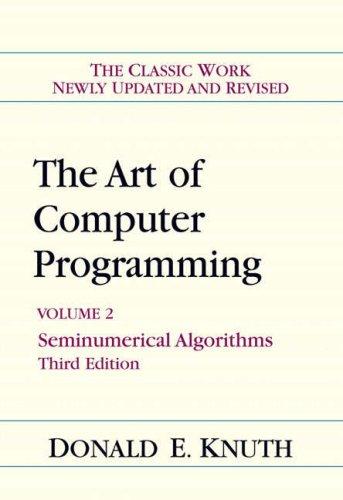
Represents the monumental foundational treatise of computer science, analyzing fundamental data structures, seminumerical algorithms, sorting, searching, and combinatorial generation with unmatched mathematical depth.
Bridges theoretical algorithmics with modern contest problem-solving, covering dynamic programming, range queries, graph traversal, and amortized analysis in C++.
Continuing the accessible approach of the series, this book focuses on graph algorithms and data structures, with analysis of their time complexity. It's valuable for understanding the performance of algorithms on interconnected data and builds upon the foundational concepts introduced in Part 1.
Explores the boundaries of computation and the complexity of problems from a broad perspective. It covers space complexity within the context of computational limits and the Church-Turing thesis. It's a good resource for gaining a wider theoretical context.
Is geared towards students participating in programming contests. It covers a wide range of algorithmic techniques, including backtracking, and provides numerous problems for practice. It's a valuable resource for advanced undergraduate and graduate students looking to hone their algorithmic skills and apply backtracking in competitive settings.
Delves into functional programming principles using Scala, where recursion primary means of iteration. It provides a deep understanding of how recursion is used in a functional context, including concepts like tail recursion and immutability. It's suitable for advanced undergraduates, graduate students, and professionals interested in functional programming paradigms. It offers a different perspective on recursion compared to imperative approaches.
This textbook offers a rigorous introduction to data structures and algorithms with implementations in C++. It covers a wide range of topics and is suitable for undergraduate computer science programs.
Focuses on explaining data structures and algorithms in clear, easy-to-understand language with practical examples. It's a great resource for developers who may not have a formal computer science background but need to grasp these concepts for interviews. It emphasizes practical application and helps solidify understanding through relatable scenarios. The second edition includes new chapters on dynamic programming and heaps and tries.

Share

Help others find this course page by sharing it with your friends and followers:

Similar courses

Here are nine courses similar to 50 Days of DSA PYTHON Dynamic Programming, Question Patterns.
Delivery Problem
Most relevant
Algorithms for DNA Sequencing
Most relevant
50 days of LeetCode in GO: Algorithms Coding Interview
Most relevant
Dynamic Programming Masterclass (2024)
Most relevant
50 days of LeetCode in C# : Algorithms Coding Interviews
Most relevant
50 Days of LeetCode in Kotlin: Algorithms Coding...
Most relevant
Python for Patterns, Problems, Data Structures &...
Most relevant
Python Data Structures & Algorithms + LEETCODE Exercises
Most relevant
Algorithmic Thinking (Part 2)
Most relevant

Udemy Buyer Protection & Guarantee

Verified partner policies & purchase protections

Global Marketplace Leader
Free Trial & Audit

Free Lecture Previews

Free preview video lectures available for all courses; optional 7-day free trial on Personal Plan subscriptions (cancel before trial ends to avoid conversion).

Return & Refund Policy

30-Day Money-Back Guarantee

30-day money-back guarantee on all eligible individual course purchases (provided course content has not been substantially consumed or downloaded). Subscription fees are non-refundable once billed.

Buyer Protections

Verified Academic & Industry Partner

Lifetime access to purchased individual courses and future updates, verifiable certificate of completion, and direct student Q&A forums.

Key Purchase Protections
30-day 100% money-back guarantee on course purchases
Lifetime access on web, mobile, and offline
Certificate of completion included with purchase
Direct instructor Q&A and active student community
OpenCourser Verified Partner Policy details last reviewed: 2026-10-22
Our mission

OpenCourser helps millions of learners each year. People visit us to learn workspace skills, ace their exams, and nurture their curiosity.

Our extensive catalog contains over 50,000 courses and twice as many books. Browse by search, by topic, or even by career interests. We'll match you to the right resources quickly.

Find this site helpful? Tell a friend about us.

Affiliate disclosure

We're supported by our community of learners. When you purchase or subscribe to courses and programs or purchase books, we may earn a commission from our partners.

Your purchases help us maintain our catalog and keep our servers humming without ads.

Thank you for supporting OpenCourser.

© 2016 - 2025 OpenCourser