We may earn an affiliate commission when you visit our partners.
Course image
Angelo Paolillo

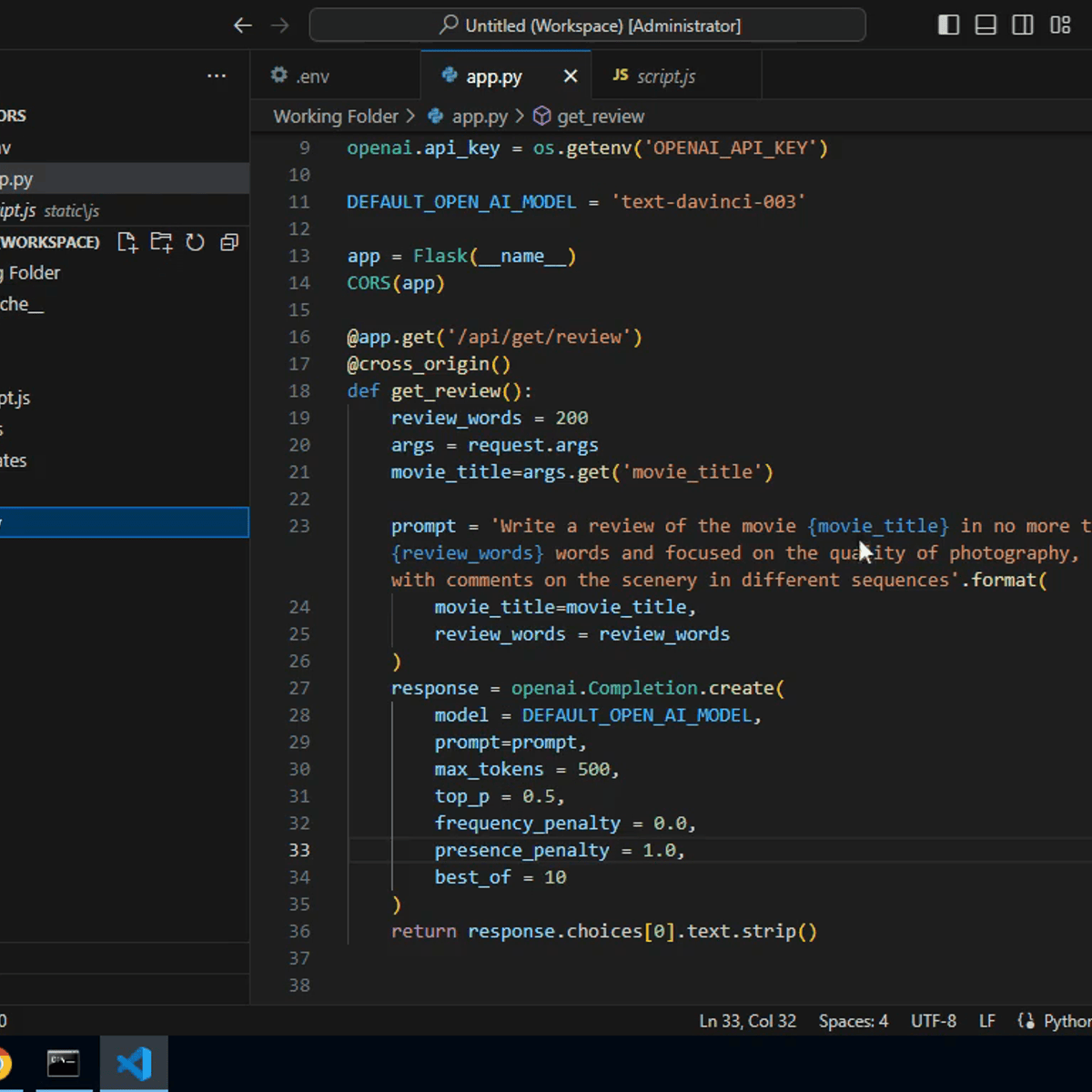
In this project you will implement, within a Flask Python web app, a dynamic generation of movie reviews in different styles generated through OpenAI text models prompting and tweaking OpenAI parameters. You will modulate the generated responses via parameters such as top_p, frequency penalty, presence penalty and best_of. Using JSON objects storing users information, you will adapt the text generation and filter the movie database depending on user characteristics such as age, interests and proficiency based on the AI model recommendations.

Enroll now

What's inside

Syllabus

Traffic lights

Read about what's good
what should give you pause
and possible dealbreakers
Teaches learners to develop robust movie review systems using OpenAI and Python
Develops intermediate to advanced skills for deploying AI and language models in practical applications
Applicable for professionals in marketing, entertainment, and data science

Save this course

Create your own learning path. Save this course to your list so you can find it easily later.
Save

Reviews summary

Openai prompting in flask apps

According to students, this course offers a highly practical and hands-on approach to programmatic prompting with OpenAI, specifically within a Flask Python web environment. Many learners found the course's focus on tweaking OpenAI parameters (like top_p and penalties) and dynamically generating content to be incredibly insightful and directly applicable. While praised for its clear explanations and project-based learning, a consistent point raised is the necessity of a strong foundational understanding of Python and Flask to fully benefit from the material, as the course moves quickly into implementation. Overall, it's seen as an excellent resource for applying AI models in real-world scenarios.
Delivers focused, up-to-date content without unnecessary fluff.
"Fantastic project-based course! It clarified how to use top_p and penalty parameters effectively and was very relevant."
"The course is straight to the point, no fluff, which I appreciated. It's a great quick dive into programmatic prompting."
"It delivers on its promise for programmatic prompting. Very relevant for modern AI development."
Provides clear understanding of OpenAI's response modulation parameters.
"The parameter tuning section was a game changer for generating nuanced responses. I finally grasped how top_p and frequency penalty influence outputs."
"I learned so much about refining AI outputs. The focus on filtering and dynamic generation was incredibly useful."
"The explanations of tweaking OpenAI parameters were very clear and practical for controlling model behavior."
Emphasizes hands-on implementation of OpenAI models in a web app.
"This course was exactly what I needed to bridge the gap between theoretical knowledge of OpenAI and practical application in a web environment."
"The hands-on coding and projects are the strongest part of the course for me, solidifying my understanding."
"I appreciate the real-world application of OpenAI models in a Flask app, it helped me implement dynamic content immediately."
Requires prior proficiency in Python and Flask development.
"If you're not comfortable with Python and Flask, be prepared for a steeper curve; the course jumps straight into code."
"I found this course somewhat difficult to follow as it assumes quite a bit of Flask knowledge."
"Not for beginners. I spent more time trying to figure out the Flask parts than learning about OpenAI. The prerequisites should be clearer."

Activities

Be better prepared before your course. Deepen your understanding during and after it. Supplement your coursework and achieve mastery of the topics covered in Programmatic Prompting with OpenAI: Refining and Filtering with these activities:
Review NLP Concepts
Review key concepts in natural language processing to build a strong foundation for the course.
Show steps
  • Revisit core NLP algorithms and techniques, such as tokenization, stemming, and POS tagging.
  • Explore different NLP libraries and frameworks, such as spaCy and NLTK.
  • Practice applying NLP techniques to analyze text data using code examples.
Read 'Natural Language Processing with Python'
Gain a comprehensive understanding of NLP concepts and techniques by reading this introductory textbook.
Show steps
  • Read and understand the key concepts and algorithms covered in each chapter.
  • Work through the practice exercises and assignments to reinforce your learning.
  • Apply the techniques to analyze real-world text data as part of a project.
Practice implementing movie review generators
Solidify understanding of text generation models by applying them to the specific task of movie review generation.
Browse courses on Text Generation
Show steps
  • Choose a prompt for the movie review generator
  • Specify parameters for the text generation, such as top_p, frequency penalty, presence penalty, and best_of
  • Generate movie reviews using the specified parameters
Five other activities
Expand to see all activities and additional details
Show all eight activities
Develop a Movie Recommendation Engine
Build a practical project that applies the concepts of NLP and machine learning to create a personalized movie recommendation system.
Browse courses on Recommender Systems
Show steps
  • Gather a dataset of movie reviews and ratings.
  • Train a machine learning model to predict movie ratings based on user preferences.
  • Design a user interface for the recommendation engine.
  • Deploy and test the recommendation engine to evaluate its performance.
Generate Movie Reviews with OpenAI
Practice using OpenAI's text generation capabilities to explore different styles of movie reviews.
Browse courses on Text Generation
Show steps
  • Experiment with various OpenAI parameters to generate diverse movie reviews.
  • Analyze the generated reviews to identify patterns and improve the quality of the output.
  • Create a collection of unique and engaging movie reviews as a portfolio.
Write a Comprehensive Guide to NLP for Beginners
Share your knowledge and understanding of NLP by creating a detailed guide that explains the concepts and applications of NLP to beginners.
Browse courses on NLP
Show steps
  • Research and gather information on key NLP concepts, algorithms, and tools.
  • Organize and structure the content into a logical and easy-to-understand format.
  • Write clear and concise explanations, supported by examples and code snippets.
  • Review and edit the guide to ensure accuracy and readability.
Explore Advanced NLP Techniques
Delve into advanced NLP techniques and explore the latest research and developments in the field.
Browse courses on Transformers
Show steps
  • Follow online tutorials or attend workshops on advanced NLP topics.
  • Read research papers and articles to stay updated with the latest advancements.
  • Experiment with state-of-the-art NLP models and libraries to gain practical experience.
Design a Chatbot Assistant
Develop a fully functional chatbot assistant that utilizes NLP techniques to engage with users and provide personalized responses.
Browse courses on Conversational AI
Show steps
  • Define the purpose and target audience of the chatbot.
  • Design the chatbot's conversational flow and user interface.
  • Train the chatbot on a relevant dataset and fine-tune its responses.
  • Deploy and test the chatbot to evaluate its effectiveness and user satisfaction.

Career center

Learners who complete Programmatic Prompting with OpenAI: Refining and Filtering will develop knowledge and skills that may be useful to these careers:
Machine Learning Engineer
Machine Learning Engineers build, deploy, and maintain machine learning models. They use their knowledge of machine learning algorithms and programming to develop models that can be used to make predictions or classifications. Programmatic Prompting with OpenAI: Refining and Filtering can help Machine Learning Engineers develop their machine learning skills and learn about new machine learning techniques.
Data Scientist
Data Scientists use their expertise to build machine learning models for various industries. They use their knowledge of programming, statistics, and data analysis to prepare data for modeling and then build models that can be used to make predictions or classifications. Programmatic Prompting with OpenAI: Refining and Filtering can help build a foundation in machine learning and programming, which are essential skills for Data Scientists.
Data Analyst
Data Analysts collect, clean, and analyze data to identify trends and patterns. They use their knowledge of statistics and data analysis techniques to interpret data and communicate their findings to others. Programmatic Prompting with OpenAI: Refining and Filtering can help Data Analysts develop their data analysis skills and learn about new data analysis techniques.
Software Engineer
Software Engineers design, develop, test, and maintain computer software. They use their knowledge of programming languages and software engineering principles to build software that meets the needs of users. Programmatic Prompting with OpenAI: Refining and Filtering can help Software Engineers develop their programming skills and learn about new programming techniques.
Product Manager
Product Managers are responsible for the development and launch of new products. They work with engineers, designers, and marketers to bring new products to market. Programmatic Prompting with OpenAI: Refining and Filtering can help Product Managers develop their communication skills and learn about new product development techniques.
Instructional Designer
Instructional Designers are responsible for designing and developing educational materials. They work with teachers and other teams to create materials that are effective and engaging. Programmatic Prompting with OpenAI: Refining and Filtering can help Instructional Designers develop their design skills and learn about new instructional design techniques.
Curriculum Developer
Curriculum Developers are responsible for developing and implementing curriculum for schools and other educational institutions. They work with teachers and other teams to create curriculum that is aligned with educational standards. Programmatic Prompting with OpenAI: Refining and Filtering can help Curriculum Developers develop their design skills and learn about new curriculum development techniques.
Educational Consultant
Educational Consultants provide guidance and support to students and families on educational matters. They work with students to help them choose the right schools and programs. Programmatic Prompting with OpenAI: Refining and Filtering can help Educational Consultants develop their communication skills and learn about new educational trends.
Career Counselor
Career Counselors provide guidance and support to individuals on career matters. They work with individuals to help them choose the right career path. Programmatic Prompting with OpenAI: Refining and Filtering can help Career Counselors develop their communication skills and learn about new career trends.
Guidance Counselor
Guidance Counselors provide guidance and support to students on academic and personal matters. They work with students to help them make decisions about their future. Programmatic Prompting with OpenAI: Refining and Filtering can help Guidance Counselors develop their communication skills and learn about new counseling techniques.
Social Worker
Social Workers provide support and guidance to individuals and families on social matters. They work with individuals to help them overcome challenges and achieve their goals. Programmatic Prompting with OpenAI: Refining and Filtering can help Social Workers develop their communication skills and learn about new social work techniques.
Marketing Manager
Marketing Managers are responsible for developing and executing marketing campaigns. They work with a variety of teams to create and implement marketing materials. Programmatic Prompting with OpenAI: Refining and Filtering can help Marketing Managers develop their communication skills and learn about new marketing techniques.
User Experience Designer
User Experience Designers are responsible for designing the user interface and user experience for websites and apps. They work with engineers and designers to create websites and apps that are easy to use and visually appealing. Programmatic Prompting with OpenAI: Refining and Filtering can help User Experience Designers develop their design skills and learn about new user experience techniques.
Content Writer
Content Writers are responsible for writing content for websites, blogs, and other marketing materials. They work with marketers and other teams to create content that is informative and engaging. Programmatic Prompting with OpenAI: Refining and Filtering can help Content Writers develop their writing skills and learn about new content writing techniques.
Technical Writer
Technical Writers are responsible for writing documentation for software and other technical products. They work with engineers and other teams to create documentation that is clear and concise. Programmatic Prompting with OpenAI: Refining and Filtering can help Technical Writers develop their writing skills and learn about new technical writing techniques.

Reading list

We've selected nine books that we think will supplement your learning. Use these to develop background knowledge, enrich your coursework, and gain a deeper understanding of the topics covered in Programmatic Prompting with OpenAI: Refining and Filtering.
Provides a comprehensive introduction to deep learning, covering the fundamental concepts and techniques used in the field. It valuable resource for anyone looking to gain a deeper understanding of deep learning and its applications.
Provides a comprehensive introduction to natural language processing, covering the fundamental concepts and techniques used in the field. It valuable resource for anyone looking to gain a deeper understanding of natural language processing and its applications.
Provides a hands-on introduction to machine learning, using the popular Python libraries Scikit-Learn, Keras, and TensorFlow. It valuable resource for anyone looking to learn how to build and deploy machine learning models.
Provides a comprehensive introduction to statistical learning, covering the fundamental concepts and techniques used in the field. It valuable resource for anyone looking to gain a deeper understanding of statistical learning and its applications.
Provides a comprehensive introduction to machine learning using the Python programming language. It covers the fundamental concepts and techniques used in the field, and valuable resource for anyone looking to learn how to build and deploy machine learning models in Python.
Provides a comprehensive introduction to machine learning using the Go programming language. It covers the fundamental concepts and techniques used in the field, and valuable resource for anyone looking to learn how to build and deploy machine learning models in Go.

Share

Help others find this course page by sharing it with your friends and followers:

Similar courses

Similar courses are unavailable at this time. Please try again later.
Our mission

OpenCourser helps millions of learners each year. People visit us to learn workspace skills, ace their exams, and nurture their curiosity.

Our extensive catalog contains over 50,000 courses and twice as many books. Browse by search, by topic, or even by career interests. We'll match you to the right resources quickly.

Find this site helpful? Tell a friend about us.

Affiliate disclosure

We're supported by our community of learners. When you purchase or subscribe to courses and programs or purchase books, we may earn a commission from our partners.

Your purchases help us maintain our catalog and keep our servers humming without ads.

Thank you for supporting OpenCourser.

© 2016 - 2025 OpenCourser