
Sorry, this page is no longer available
We may earn an affiliate commission when you visit our partners.
Course image
Angelo Paolillo

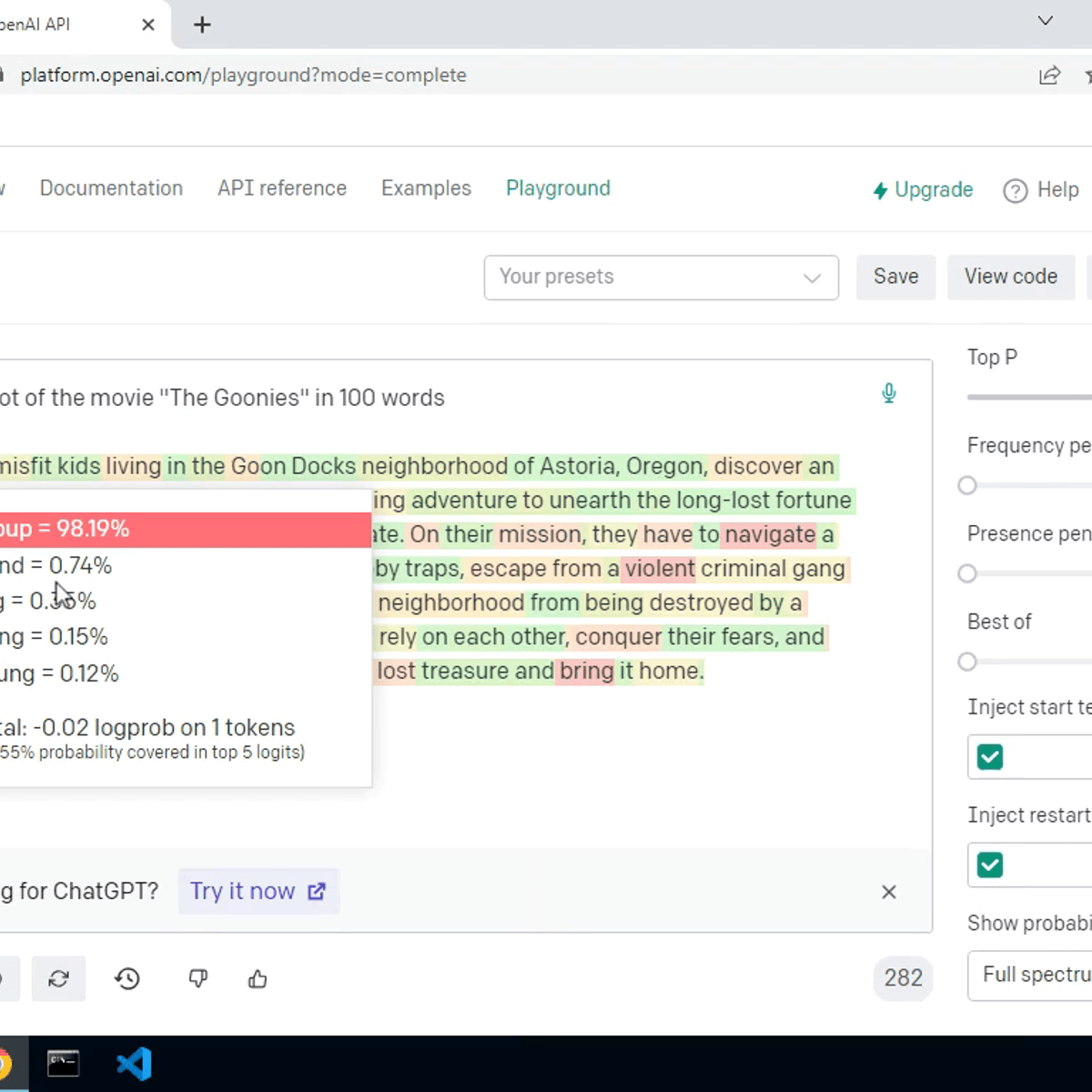
In this project you will programmatically prompt an OpenAI model using the OpenAI API, and utilize the AI to enrich data of an existing movie collection. You will use Python to prompt the davinci-003 OpenAI model based on JSON objects storing details of the user's movie collection. You will enrich the movie collection with data such as director, genre and year of release, as well as dynamically generating the movie plots, through the OpenAI model. You will also learn how to calibrate the model response using the temperature parameter. Learners in this project will create a dynamic AI-driven data enrichment and content generation system for a movie database web app.

Read more

In this project you will programmatically prompt an OpenAI model using the OpenAI API, and utilize the AI to enrich data of an existing movie collection. You will use Python to prompt the davinci-003 OpenAI model based on JSON objects storing details of the user's movie collection. You will enrich the movie collection with data such as director, genre and year of release, as well as dynamically generating the movie plots, through the OpenAI model. You will also learn how to calibrate the model response using the temperature parameter. Learners in this project will create a dynamic AI-driven data enrichment and content generation system for a movie database web app.

This project will help developers to implement OpenAI in their projects, using the AI model beyond ChatGPT, generating content or enriching data using an AI model.

The prerequisites of this project include fundamental knowledge of programming principles, particularly Python and JSON fundamentals. In the course of the project you will create an OpenAI account and use API credits. Any new account will allow 5 US Dollars worth of free credit, which is more than enough to complete the project.

PLEASE NOTE: if you already have an OpenAI account and are unable to avail of the free credit, you may incur costs for using OpenAI API.

Enroll now

Here's a deal for you

Save money when you learn with a deal that may be relevant to this course.
All coupon codes, vouchers, and discounts are applied automatically unless otherwise noted.

What's inside

Syllabus

Traffic lights

Read about what's good
what should give you pause
and possible dealbreakers
Develops AI and English communication skills, which are core skills for data scientists and content writers
Taught by Angelo Paolillo, who are recognized for their work in AI
Explores AI, which is standard in industry
Teaches Python, which helps learners code AI
Requires Python experience, which may be a barrier to entry for some learners
Requires OpenAI account and API credits, which may incur costs for some learners

Save this course

Create your own learning path. Save this course to your list so you can find it easily later.
Save

Reviews summary

Beginner openai api prompting (needs update)

According to students, this course offers a strong foundational introduction to programmatic prompting using the OpenAI API with Python, featuring practical, project-based learning and clear explanations of core concepts. However, recent feedback highlights a significant challenge: the course relies on the outdated `davinci-003` model, making many hands-on exercises impossible to follow without learners undertaking substantial code modifications. This critical issue means the course, while conceptually sound, now struggles to provide an immediately functional learning experience, with many calling for urgent updates.
Instructors explain Python, JSON, and API parameters clearly for beginners.
"The Python explanations were clear for beginners."
"The explanations of Python and JSON were clear, and the `temperature` parameter was well explained."
"The step-by-step guidance was easy to follow, and the API usage was well-explained."
Learners benefit from a practical, real-world movie data enrichment project.
"The project-based approach was really helpful, and I loved enriching the movie data."
"The movie database project is a good hands-on way to learn."
"The project was engaging and practical for understanding how to enrich data."
"I created a dynamic AI-driven data enrichment and content generation system for a movie database web app."
Provides a solid initial understanding of programmatic AI prompting.
"Excellent introduction to the OpenAI API for someone new to programmatic prompting."
"A solid beginner course. It covers the basics of using the OpenAI API with Python effectively."
"This course delivered exactly what it promised. It demystified programmatic prompting and showed me how to integrate AI..."
Requires immediate updates to current OpenAI models to remain functional.
"The instructor should update this urgently."
"I'm concerned future learners will struggle unless the course is updated to a current model like `gpt-3.5-turbo`."
"I just hope it gets updated soon for current models. Otherwise, its practical utility is very limited."
Course relies on a deprecated OpenAI model, hindering practical application.
"The core issue is the use of the `davinci-003` model. This model has been deprecated and isn't available anymore, making the practical exercises impossible..."
"Completely outdated! The `davinci-003` model is no longer supported by OpenAI. The entire course relies on it. Wasted time trying to debug API calls that just error out."
"I had to spend a lot of time trying to adapt the code to `gpt-3.5-turbo`, which defeats the purpose of a beginner course."

Activities

Be better prepared before your course. Deepen your understanding during and after it. Supplement your coursework and achieve mastery of the topics covered in Open AI for Beginners: Programmatic Prompting with these activities:
Review the Fundamentals of Python Programming
Reinforce your foundational knowledge of Python programming principles to prepare for the course.
Show steps
  • Revise core Python syntax and data types.
  • Practice writing simple Python scripts to implement basic programming concepts.
  • Review object-oriented programming principles in Python.
Participate in Discussion Forums
Engage with fellow learners by participating in discussions, sharing insights, and asking questions.
Show steps
  • Join the course discussion forum.
  • Actively participate in discussions by sharing your thoughts and responding to others.
  • Ask questions and seek clarification when needed.
Explore OpenAI API Tutorials
Enhance your understanding of the OpenAI API by following guided tutorials and exploring its features.
Browse courses on OpenAI API
Show steps
  • Complete the official OpenAI API tutorial.
  • Investigate additional tutorials and resources on using the OpenAI API.
  • Experiment with the API by making sample requests and analyzing the responses.
Two other activities
Expand to see all activities and additional details
Show all five activities
Read 'Automating Inequality' by Virginia Eubanks
Explore the societal implications of AI and data-driven technologies by reading this insightful book.
Show steps
  • Read the book and take notes on key concepts and arguments.
  • Reflect on how the ideas presented in the book relate to the course materials.
  • Participate in discussions about the book's themes and implications.
Develop an AI-Driven Movie Data Enrichment Application
Apply your learning by creating a practical application that leverages OpenAI to enrich movie data.
Show steps
  • Design the architecture and functionality of the application.
  • Integrate the OpenAI API with your application.
  • Develop a user interface for collecting movie data and generating AI-enriched results.
  • Test and refine the application to ensure accuracy and user-friendliness.

Career center

Learners who complete Open AI for Beginners: Programmatic Prompting will develop knowledge and skills that may be useful to these careers:
Machine Learning Researcher
Machine Learning Researchers use their programming skills to conduct research in the field of machine learning. As an Open AI for Beginners: Programmatic Prompting course learner, you will learn how to programmatically prompt an OpenAI model using the OpenAI API. This skill can be applied to machine learning research tasks such as developing new machine learning algorithms and evaluating machine learning models.
Artificial Intelligence Specialist
Artificial Intelligence Specialists use their programming skills to develop and deploy artificial intelligence solutions. As an Open AI for Beginners: Programmatic Prompting course learner, you will learn how to programmatically prompt an OpenAI model using the OpenAI API. This skill can be applied to artificial intelligence tasks such as creating natural language processing models and image recognition models.
Machine Learning Engineer
Machine Learning Engineers design, develop, and implement machine learning models. As an Open AI for Beginners: Programmatic Prompting course learner, you will learn how to programmatically prompt an OpenAI model using the OpenAI API. This skill can be applied to machine learning tasks such as model training and evaluation, which are essential for building and deploying successful machine learning applications.
Data Analyst
Data Analysts use their programming skills to analyze and interpret data in order to create reports and visualizations that can help businesses make better decisions. As an Open AI for Beginners: Programmatic Prompting course learner, you will learn how to programmatically prompt an OpenAI model using the OpenAI API. This skill can be applied to data analysis tasks such as data cleaning and feature engineering, which are essential for building accurate and reliable machine learning models.
Data Scientist
Data Scientists use their programming skills to collect, analyze, and interpret data in order to solve business problems. As an Open AI for Beginners: Programmatic Prompting course learner, you will learn how to programmatically prompt an OpenAI model using the OpenAI API. This skill can be applied to data science tasks such as data mining and predictive modeling, which are essential for making informed decisions and driving business growth.
Business Analyst
Business Analysts use their programming skills to analyze and interpret business data in order to identify opportunities and solve problems. As an Open AI for Beginners: Programmatic Prompting course learner, you will learn how to programmatically prompt an OpenAI model using the OpenAI API. This skill can be applied to business analysis tasks such as market research and competitive analysis, which are essential for developing successful business strategies.
Product Manager
Product Managers use their programming skills to build and manage software products. As an Open AI for Beginners: Programmatic Prompting course learner, you will learn how to programmatically prompt an OpenAI model using the OpenAI API. This skill can be applied to product management tasks such as developing product roadmaps and managing product releases, which are essential for building successful software products.
Project Manager
Project Managers use their programming skills to plan and manage projects. As an Open AI for Beginners: Programmatic Prompting course learner, you will learn how to programmatically prompt an OpenAI model using the OpenAI API. This skill can be applied to project management tasks such as creating project plans and managing project budgets, which are essential for delivering successful projects.
Marketing Manager
Marketing Managers use their programming skills to create and manage marketing campaigns. As an Open AI for Beginners: Programmatic Prompting course learner, you will learn how to programmatically prompt an OpenAI model using the OpenAI API. This skill can be applied to marketing tasks such as creating marketing content and managing social media campaigns, which are essential for reaching target audiences and driving business growth.
Sales Manager
Sales Managers use their programming skills to build and manage sales teams. As an Open AI for Beginners: Programmatic Prompting course learner, you will learn how to programmatically prompt an OpenAI model using the OpenAI API. This skill can be applied to sales tasks such as creating sales materials and managing customer relationships, which are essential for generating sales and driving revenue.
Finance Manager
Finance Managers use their programming skills to manage the financial aspects of an organization. As an Open AI for Beginners: Programmatic Prompting course learner, you will learn how to programmatically prompt an OpenAI model using the OpenAI API. This skill can be applied to finance tasks such as creating financial reports and managing budgets, which are essential for ensuring the financial health of an organization.
Operations Manager
Operations Managers use their programming skills to manage the day-to-day operations of an organization. As an Open AI for Beginners: Programmatic Prompting course learner, you will learn how to programmatically prompt an OpenAI model using the OpenAI API. This skill can be applied to operations tasks such as creating process flows and managing inventory, which are essential for ensuring the smooth running of an organization.
Human Resources Manager
Human Resources Managers use their programming skills to manage the human resources aspects of an organization. As an Open AI for Beginners: Programmatic Prompting course learner, you will learn how to programmatically prompt an OpenAI model using the OpenAI API. This skill can be applied to human resources tasks such as creating employee handbooks and managing employee benefits, which are essential for building a successful workforce.
Web Developer
Web Developers design, develop, and maintain websites and web applications. As an Open AI for Beginners: Programmatic Prompting course learner, you will learn how to programmatically prompt an OpenAI model using the OpenAI API. This skill can be applied to web development tasks such as building dynamic and interactive web pages, which can be used to create engaging and informative user experiences.
Software Engineer
Software Engineers design, develop, and maintain software applications. As an Open AI for Beginners: Programmatic Prompting course learner, you will learn how to programmatically prompt an OpenAI model using the OpenAI API. This skill can be applied to software engineering tasks such as building web applications, mobile applications, and desktop applications.

Reading list

We've selected 12 books that we think will supplement your learning. Use these to develop background knowledge, enrich your coursework, and gain a deeper understanding of the topics covered in Open AI for Beginners: Programmatic Prompting.
Is the definitive reference on deep learning. It covers a wide range of topics, from the basics of neural networks to the latest advances in the field. It is essential reading for anyone serious about learning about deep learning.
Is the definitive reference on reinforcement learning. It covers a wide range of topics, from the basics of reinforcement learning to the latest advances in the field. It is essential reading for anyone serious about learning about reinforcement learning.
Provides a comprehensive overview of machine learning from a probabilistic perspective. It covers a wide range of topics, from Bayesian inference to reinforcement learning. It great resource for those looking to gain a solid understanding of the field.
Provides a comprehensive overview of pattern recognition and machine learning. It covers a wide range of topics, from supervised learning to unsupervised learning. It great resource for those looking to gain a solid understanding of the field.
Provides a comprehensive overview of speech and language processing, covering a wide range of topics from speech recognition to natural language understanding. It great resource for those looking to gain a solid understanding of the field.
Provides a comprehensive overview of statistical learning, covering a wide range of topics from linear regression to support vector machines. It great resource for those looking to gain a solid understanding of the field.
Provides a comprehensive overview of information theory, inference, and learning algorithms. It covers a wide range of topics, from Shannon's entropy to Bayesian networks. It great resource for those looking to gain a solid understanding of the field.
Practical guide to building and deploying deep learning models using Python. It covers a wide range of topics, from neural networks to convolutional neural networks. It is written in a clear and concise style, and great resource for those looking to get started with deep learning.
Provides a comprehensive overview of computer vision, covering the latest algorithms and applications. It is written in a clear and concise style, and great resource for those looking to gain a solid understanding of the field.
Provides a comprehensive overview of convex optimization, covering a wide range of topics from linear programming to interior-point methods. It great resource for those looking to gain a solid understanding of the field.
Practical guide to building and deploying machine learning models. It covers a wide range of topics, from data preparation to model evaluation. It is written in a clear and concise style, and great resource for those looking to get started with machine learning.
Provides a comprehensive overview of artificial intelligence, covering its basic concepts, applications, and ethical implications. It great resource for those looking to gain a solid understanding of AI's potential and limitations.

Share

Help others find this course page by sharing it with your friends and followers:

Similar courses

Similar courses are unavailable at this time. Please try again later.
Our mission

OpenCourser helps millions of learners each year. People visit us to learn workspace skills, ace their exams, and nurture their curiosity.

Our extensive catalog contains over 50,000 courses and twice as many books. Browse by search, by topic, or even by career interests. We'll match you to the right resources quickly.

Find this site helpful? Tell a friend about us.

Affiliate disclosure

We're supported by our community of learners. When you purchase or subscribe to courses and programs or purchase books, we may earn a commission from our partners.

Your purchases help us maintain our catalog and keep our servers humming without ads.

Thank you for supporting OpenCourser.

© 2016 - 2025 OpenCourser