We may earn an affiliate commission when you visit our partners.
Course image
Ishita Sinha

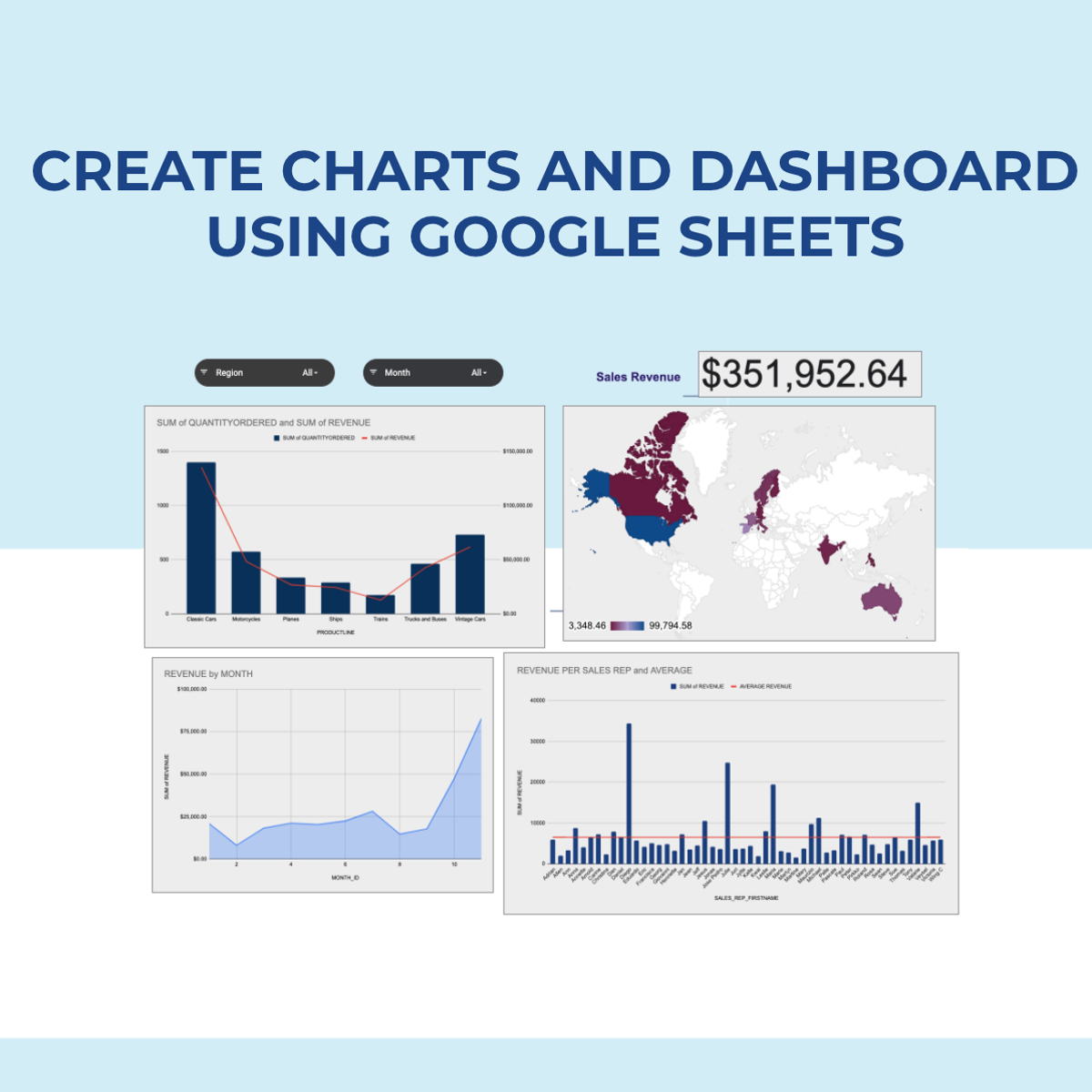
In this 2-hour long project-based course, you will learn how to create effective charts and a dynamic dashboard to visualize data sets. You will be able to work with vlookups, pivot tables and basic formulas and be able to create dynamic charts, sparklines, and a robust, dynamic dashboard to present the data.

By the end of the project you will be able to:

- Understand the terminologies of spreadsheets

- Work with basic formulas in Google Sheets

- Create 8 Basic Charts for visualizing data

- Generate Dynamic Charts from a dropdown list

- Generate Sparklines to represent data

Read more

In this 2-hour long project-based course, you will learn how to create effective charts and a dynamic dashboard to visualize data sets. You will be able to work with vlookups, pivot tables and basic formulas and be able to create dynamic charts, sparklines, and a robust, dynamic dashboard to present the data.

By the end of the project you will be able to:

- Understand the terminologies of spreadsheets

- Work with basic formulas in Google Sheets

- Create 8 Basic Charts for visualizing data

- Generate Dynamic Charts from a dropdown list

- Generate Sparklines to represent data

- Build a dashboard and introduce Basic and Advanced Charts

- Use Slicers to filter data and create a robust and dynamic dashboard

Note: If you don't have a Google account, you will need to create one to be able to complete the content.

Enroll now

What's inside

Syllabus

Traffic lights

Read about what's good
what should give you pause
and possible dealbreakers
Suitable for beginners who want to develop core skills in data visualization with Google Sheets
Taught by Ishita Sinha, who is an experienced instructor in data visualization
Explores the use of basic formulas, pivot tables, and vlookups for data analysis
Covers a range of charting techniques, including dynamic charts, sparklines, and dashboards
Provides hands-on practice through a project-based approach

Save this course

Create your own learning path. Save this course to your list so you can find it easily later.
Save

Reviews summary

Google sheets dashboard essentials for beginners

According to students, this project-based course on Google Sheets is a highly practical and effective introduction to creating charts and dynamic dashboards. Learners consistently praise its clear explanations, particularly for essential functions like VLOOKUP, pivot tables, and sparklines. The concise 2-hour format is frequently highlighted as ideal for busy professionals seeking immediate skill application. While perfect for beginners and those new to spreadsheets, some experienced users found the content too simplistic, wishing for more advanced techniques or complex data scenarios.
Instructor provides clear, easy-to-follow explanations of core functions.
"The instructor was clear, and the explanations of formulas like VLOOKUP and how to create sparklines were incredibly clear."
"I found the VLOOKUP and pivot table explanations quite useful, even though I had some prior knowledge."
"Very clear and helpful. I now understand pivot tables and VLOOKUP much better and can apply them to my daily tasks."
"The instructions were always precise."
The short duration is highly valued for quick skill acquisition.
"A solid introduction... very good for its length."
"Excellent concise course! Perfect for a busy work schedule."
"This course is brilliant for getting a rapid understanding of Google Sheets' visualization capabilities. The 2-hour format is perfect for busy professionals."
"The 2-hour format is perfect for busy professionals. I learned how to create a useful dashboard in a very short time."
Clearly structured and easy to follow for new spreadsheet users.
"As a complete beginner to Google Sheets, this course was a godsend. It's structured perfectly for quick learning and immediate application."
"I now feel confident using Sheets for basic data visualization at work. Highly recommend for new users."
"A well-structured course for beginners. It provides a solid foundation for creating basic charts and an interactive dashboard."
"The explanations of formulas like VLOOKUP and how to create sparklines were incredibly clear."
Focuses on hands-on application for immediate skill development.
"This course was exactly what I needed to get started with Google Sheets for dashboards. The hands-on project made it very practical."
"It really helped me build my first interactive dashboard in Google Sheets for my marketing reports. The steps were easy to follow."
"I learned how to combine different elements like pivot tables and dynamic charts into a functional dashboard. It fulfills its promise."
"The project-based learning was incredibly effective. I learned how to create a useful dashboard in a very short time."
May be too simplistic for those with prior spreadsheet knowledge.
"The course is okay. It covers the basics, but if you already know a bit about spreadsheets, it might feel too simplistic."
"I was hoping for more advanced dashboard techniques or deeper dives into complex formulas. Not for someone looking to level up existing skills significantly."
"Found this course too basic and not challenging enough. The data set used was extremely simple, and the dashboard created is very rudimentary."
"While it's great for beginners, I felt it could have elaborated more on best practices for dashboard design or more complex data scenarios."

Activities

Be better prepared before your course. Deepen your understanding during and after it. Supplement your coursework and achieve mastery of the topics covered in Create Charts and Dashboard using Google Sheets with these activities:
Review the book 'Google Sheets for Data Analysis' by Ben Collins
Review the book 'Google Sheets for Data Analysis' to gain a deeper understanding of data analysis techniques using Google Sheets.
Show steps
  • Read the book and take notes on key concepts
  • Apply the techniques described in the book to your own projects
Gather resources on data visualization best practices and tools
Gather resources on data visualization best practices and tools to enhance your knowledge and skills.
Browse courses on Data Visualization
Show steps
  • Search for articles, tutorials, and other resources on data visualization
  • Create a collection of useful resources
  • Review the resources and apply the best practices to your own work
Create basic charts to visualize different types of data
Create basic charts to visualize different types of data and practice your charting skills.
Show steps
  • Gather sample data
  • Create different types of charts (e.g., bar, line, pie)
  • Analyze the charts and identify key insights and trends
Five other activities
Expand to see all activities and additional details
Show all eight activities
Join a study group or online forum and discuss data visualization techniques
Join a study group or online forum to discuss data visualization techniques and learn from others.
Browse courses on Data Visualization
Show steps
  • Find a study group or online forum
  • Participate in discussions and ask questions
  • Share your own knowledge and insights
Practice using vlookups, pivot tables, and basic formulas in Google Sheets
Practice using vlookups, pivot tables, and basic formulas to improve your proficiency in Google Sheets.
Browse courses on Google Sheets
Show steps
  • Find and use vlookups to retrieve data
  • Create and use pivot tables to summarize and analyze data
  • Use basic formulas to perform calculations and manipulate data
Create a dashboard using Google Sheets
Build a dashboard to visualize data, reinforcing your understanding of charts, formulas, and data manipulation techniques.
Browse courses on Google Sheets
Show steps
  • Organize data in a Google Sheet
  • Learn and apply basic formulas
  • Create visualizations using charts
  • Build a dynamic dashboard
Follow online tutorials on creating dynamic charts and dashboards in Google Sheets
Follow online tutorials to learn how to create dynamic charts and dashboards in Google Sheets.
Browse courses on Dynamic Charts
Show steps
  • Find and watch tutorials on creating dynamic charts
  • Find and watch tutorials on creating dashboards
  • Follow the steps in the tutorials and try creating your own charts and dashboards
Create a data visualization dashboard using Google Sheets
Create a data visualization dashboard to showcase your understanding of Google Sheets and data visualization techniques.
Browse courses on Data Visualization
Show steps
  • Gather and clean the data
  • Create charts and graphs to visualize the data
  • Design and create a professional-looking dashboard

Career center

Learners who complete Create Charts and Dashboard using Google Sheets will develop knowledge and skills that may be useful to these careers:
Data Analyst
Data Analysts use data to solve business problems. They clean and analyze data, and then present their findings to stakeholders. This course can help you develop the skills you need to become a Data Analyst. You will learn how to clean data, perform basic functions and formulas, and create charts and dashboards. These skills are essential for Data Analysts, and this course will give you a strong foundation for a successful career in this field.
Business Intelligence Analyst
Business Intelligence Analysts use data to help businesses make better decisions. They analyze data to identify trends and patterns, and then develop recommendations for how businesses can improve their operations. This course can help you develop the skills you need to become a Business Intelligence Analyst. You will learn how to clean data, perform basic functions and formulas, and create charts and dashboards. These skills are essential for Business Intelligence Analysts, and this course will give you a strong foundation for a successful career in this field.
Data Scientist
Data Scientists use data to build models that can predict future outcomes. They use a variety of techniques, including machine learning and statistical modeling. This course can help you develop the skills you need to become a Data Scientist. You will learn how to clean data, perform basic functions and formulas, and create charts and dashboards. These skills are essential for Data Scientists, and this course will give you a strong foundation for a successful career in this field.
Statistician
Statisticians use data to make inferences about populations. They design and conduct surveys, and then analyze the data to draw conclusions. This course can help you develop the skills you need to become a Statistician. You will learn how to clean data, perform basic functions and formulas, and create charts and dashboards. These skills are essential for Statisticians, and this course will give you a strong foundation for a successful career in this field.
Financial Analyst
Financial Analysts use data to evaluate investments. They analyze financial statements and other data to make recommendations about whether to buy or sell stocks, bonds, or other financial instruments. This course can help you develop the skills you need to become a Financial Analyst. You will learn how to clean data, perform basic functions and formulas, and create charts and dashboards. These skills are essential for Financial Analysts, and this course will give you a strong foundation for a successful career in this field.
Market Research Analyst
Market Research Analysts use data to understand consumer behavior. They conduct surveys and focus groups, and then analyze the data to identify trends and patterns. This course can help you develop the skills you need to become a Market Research Analyst. You will learn how to clean data, perform basic functions and formulas, and create charts and dashboards. These skills are essential for Market Research Analysts, and this course will give you a strong foundation for a successful career in this field.
Operations Research Analyst
Operations Research Analysts use data to improve the efficiency of business operations. They use a variety of techniques, including linear programming and simulation, to develop solutions to business problems. This course can help you develop the skills you need to become an Operations Research Analyst. You will learn how to clean data, perform basic functions and formulas, and create charts and dashboards. These skills are essential for Operations Research Analysts, and this course will give you a strong foundation for a successful career in this field.
Quantitative Analyst
Quantitative Analysts use data to develop models for financial markets. They use a variety of techniques, including statistical modeling and machine learning, to develop models that can predict future prices of stocks, bonds, and other financial instruments. This course can help you develop the skills you need to become a Quantitative Analyst. You will learn how to clean data, perform basic functions and formulas, and create charts and dashboards. These skills are essential for Quantitative Analysts, and this course will give you a strong foundation for a successful career in this field.
Risk Analyst
Risk Analysts use data to assess the risk of financial investments. They analyze financial data and other information to identify potential risks and develop strategies to mitigate them. This course can help you develop the skills you need to become a Risk Analyst. You will learn how to clean data, perform basic functions and formulas, and create charts and dashboards. These skills are essential for Risk Analysts, and this course will give you a strong foundation for a successful career in this field.
Data Visualization Specialist
Data Visualization Specialists use data to create visual representations of data. They use a variety of tools and techniques to create charts, graphs, and other visuals that can help people understand data. This course can help you develop the skills you need to become a Data Visualization Specialist. You will learn how to clean data, perform basic functions and formulas, and create charts and dashboards. These skills are essential for Data Visualization Specialists, and this course will give you a strong foundation for a successful career in this field.
Information Security Analyst
Information Security Analysts use data to protect computer systems and networks from security threats. They analyze data to identify vulnerabilities and develop strategies to mitigate them. This course can help you develop the skills you need to become an Information Security Analyst. You will learn how to clean data, perform basic functions and formulas, and create charts and dashboards. These skills are essential for Information Security Analysts, and this course will give you a strong foundation for a successful career in this field.
Software Engineer
Software Engineers use data to design and develop software applications. They use a variety of programming languages and tools to create software that meets the needs of users. This course can help you develop the skills you need to become a Software Engineer. You will learn how to clean data, perform basic functions and formulas, and create charts and dashboards. These skills are essential for Software Engineers, and this course will give you a strong foundation for a successful career in this field.
Web Developer
Web Developers use data to create and maintain websites. They use a variety of programming languages and tools to create websites that are both functional and visually appealing. This course can help you develop the skills you need to become a Web Developer. You will learn how to clean data, perform basic functions and formulas, and create charts and dashboards. These skills are essential for Web Developers, and this course will give you a strong foundation for a successful career in this field.
Database Administrator
Database Administrators use data to manage and maintain databases. They use a variety of tools and techniques to ensure that databases are running smoothly and efficiently. This course can help you develop the skills you need to become a Database Administrator. You will learn how to clean data, perform basic functions and formulas, and create charts and dashboards. These skills are essential for Database Administrators, and this course will give you a strong foundation for a successful career in this field.
Computer Systems Analyst
Computer Systems Analysts use data to analyze and design computer systems. They use a variety of tools and techniques to identify and solve problems with computer systems. This course can help you develop the skills you need to become a Computer Systems Analyst. You will learn how to clean data, perform basic functions and formulas, and create charts and dashboards. These skills are essential for Computer Systems Analysts, and this course will give you a strong foundation for a successful career in this field.

Reading list

We've selected 11 books that we think will supplement your learning. Use these to develop background knowledge, enrich your coursework, and gain a deeper understanding of the topics covered in Create Charts and Dashboard using Google Sheets.
Provides a comprehensive overview of Google Sheets, including how to create and format spreadsheets, use formulas and functions, and create charts and graphs.
Covers more advanced topics in Google Sheets, such as using macros, scripts, and add-ons.
Provides a beginner-friendly introduction to data visualization, including how to choose the right charts and graphs for different types of data.
Tableau powerful data visualization tool, and this book provides a comprehensive overview of how to use it.
Provides a comprehensive overview of Excel, including how to create and format spreadsheets, use formulas and functions, and create charts and graphs.
R powerful statistical programming language, and this book provides a comprehensive overview of how to use it for data analysis.
Provides a beginner-friendly introduction to blockchain technology, including how to build and use blockchain applications.

Share

Help others find this course page by sharing it with your friends and followers:

Similar courses

Similar courses are unavailable at this time. Please try again later.
Our mission

OpenCourser helps millions of learners each year. People visit us to learn workspace skills, ace their exams, and nurture their curiosity.

Our extensive catalog contains over 50,000 courses and twice as many books. Browse by search, by topic, or even by career interests. We'll match you to the right resources quickly.

Find this site helpful? Tell a friend about us.

Affiliate disclosure

We're supported by our community of learners. When you purchase or subscribe to courses and programs or purchase books, we may earn a commission from our partners.

Your purchases help us maintain our catalog and keep our servers humming without ads.

Thank you for supporting OpenCourser.

© 2016 - 2025 OpenCourser