
We may earn an affiliate commission when you visit our partners.
Course image
Dr Kirill Aristovich
Read more

Here's a deal for you

Save money when you learn with a deal that may be relevant to this course.
All coupon codes, vouchers, and discounts are applied automatically unless otherwise noted.

Traffic lights

Read about what's good
what should give you pause
and possible dealbreakers
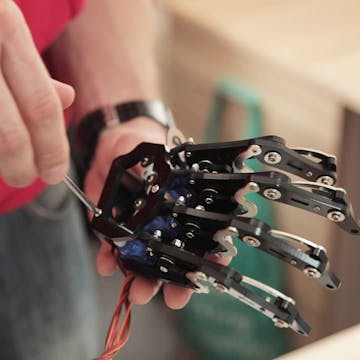
Examines practical basics of biomedical engineering, including human-robotic interfaces and bionic prosthetics
Taught by Dr Kirill Aristovich, professor at Peter the Great St. Petersburg Polytechnic University
Supported by University College London (UCL), which is recognized for its research in biomedical engineering
Teaches practical concepts used in engineering environments for designing and prototyping new ideas
Covers electronics, control theory, microcontrollers (Arduino), and high-level programming (MATLAB), providing a comprehensive foundation for biomedical engineering
Students will be able to design electronic systems for signal acquisition, connect and program microcontrollers, transmit data between controllers and PCs, process signals, and control robots with acquired signals in real-time

Save this course

Create your own learning path. Save this course to your list so you can find it easily later.
Save

Reviews summary

Biomedical engineering basics

This course provides a strong foundation in essential biomedical engineering topics. It covers a wide range of concepts including electronics, control theory, microcontrollers, and programming, making it suitable for students of all engineering backgrounds. Despite some feedback about the pace and difficulty level, the course is highly recommended for anyone interested in biomedical engineering.
Comprehensive and specific
"The course covers a lot of disciplines in a relatively short material"
"It is a fairly comprehensive and specific course, the topics are essential for a biomedical system."
Challenging but rewarding
"It was challenging for an intro course, but it was worth it."
"I'm just glad that I've managed to finish it."
MATLAB programming included
"The course covers a lot of disciplines in a relatively short material"
"But the most exciting part was biomedical circuit design and visualization of the circuit through Thinkercad."
Hands-on projects and exercises
"By the end of the course, the students will be able to practically understand and design electronic systems for electrophysiological signal acquisition..."
"The course take a dive into transfer functions, second order system, arduino, matlab."
Limited instructor feedback
"The forums had the same doubts and no curse instructor feedback as such."
"Unattended forumTeacher just reads on videos the documentation provided, with a meaningless intonation, like he doesn´t really understand what he´s saying"

Activities

Coming soon We're preparing activities for Introduction to Biomedical Engineering . These are activities you can do either before, during, or after a course.

Career center

Learners who complete Introduction to Biomedical Engineering will develop knowledge and skills that may be useful to these careers:
Biomedical Engineer
A Biomedical Engineer designs medical devices that solve clinical problems.  An understanding of electronics, control theory, microcontrollers, and high-level programming is very important for this role.  This course covers all of those topics, as well as the practical basics needed in order to be successful as a Biomedical Engineer. 
Prosthetist
A Prosthetist designs, fits, and builds artificial limbs and other devices to replace missing limbs or to assist with limb function.  This course teaches the development of human-robotic interfaces and systems such as bionic prosthetics.  The Prosthetist role depends on the ability to understand and design electronic systems for electrophysiological signal acquisition and to connect and program microcontrollers to control prosthetics.  This course teaches all the necessary skills for success in the Prosthetist role. 
Robotics Engineer
A Robotics Engineer designs, builds, and maintains robots.  This course teaches the basics of developing human-robotic interfaces and systems such as bionic prosthetics.  Those foundational skills are also the basis for the advanced knowledge needed in Robotics Engineering.  This course teaches electronics, control theory, microcontrollers, and high-level programming - all skills that are required by Robotics Engineers. 
Electrical Engineer
An Electrical Engineer designs, develops, tests, and supervises the installation of electrical systems and equipment.  This course teaches electronics, control theory, microcontrollers, and high-level programming.  These skills are all foundational to Electrical Engineers.  Many Electrical Engineers work in biomedical engineering or robotics. 
Mechanical Engineer
A Mechanical Engineer designs, develops, builds, and tests mechanical systems.  This course teaches electronics, control theory, microcontrollers, and high-level programming.  These skills are all foundational to Mechanical Engineers.  Many Mechanical Engineers work in biomedical engineering or robotics. 
Computer Science Engineer
A Computer Science Engineer designs, develops, and maintains software systems.  This course teaches microcontrollers and high-level programming.  These skills are required by Computer Science Engineers, especially those who work in biomedical engineering or robotics. 
Biomedical Equipment Technician
A Biomedical Equipment Technician installs, maintains, and repairs biomedical equipment.  This course teaches electronics, control theory, microcontrollers, and high-level programming.  These skills allow a Biomedical Equipment Technician to understand and maintain the equipment used in hospitals and other medical settings. 
Medical Physicist
A Medical Physicist applies the principles of physics to medicine.  This course teaches electronics, control theory, microcontrollers, and high-level programming.  These skills are required by Medical Physicists who work in research and development of new medical technologies. 
Science Teacher
A Science Teacher teaches science to students at various levels.  This course teaches electronics, control theory, microcontrollers, and high-level programming.  These skills may be taught at an advanced level and can help to prepare students for careers in engineering or other scientific fields. 
Technical Writer
A Technical Writer creates instruction manuals, technical reports, and other documents that explain complex technical information.  This course teaches electronics, control theory, microcontrollers, and high-level programming.  These skills help a Technical Writer to understand the technical information that they are writing about. 
Product Manager
A Product Manager manages the development and marketing of a product.  This course teaches electronics, control theory, microcontrollers, and high-level programming.  These skills help a Product Manager to understand the technical aspects of the product. 
Patent Attorney
A Patent Attorney helps inventors to obtain patents for their inventions.  This course teaches electronics, control theory, microcontrollers, and high-level programming.  These skills help a Patent Attorney to understand the technical aspects of the inventions that they are working with. 
Entrepreneur
An Entrepreneur starts and runs a business.  This course teaches electronics, control theory, microcontrollers, and high-level programming.  These skills may be useful for an Entrepreneur who is starting a business in a technical field. 
Consultant
A Consultant provides expert advice to businesses and organizations.  This course teaches electronics, control theory, microcontrollers, and high-level programming.  These skills may be useful for a Consultant who is working in a technical field. 
Researcher
A Researcher conducts research in a particular field.  This course teaches electronics, control theory, microcontrollers, and high-level programming.  These skills may be useful for a Researcher who is working in a technical field. 

Reading list

We've selected 11 books that we think will supplement your learning. Use these to develop background knowledge, enrich your coursework, and gain a deeper understanding of the topics covered in Introduction to Biomedical Engineering .
This handbook comprehensive reference that covers all aspects of biomedical engineering. It valuable resource for students, researchers, and practitioners in the field.
This textbook is commonly used in introductory biomedical engineering courses. It provides a broad overview of the field, covering topics such as biomaterials, biomechanics, and medical imaging.
This textbook covers the systems approach to biomedical engineering, including topics such as modeling, simulation, and control. It good choice for students who are interested in learning more about this important aspect of biomedical engineering.
Takes a systems approach to biomedical engineering, focusing on the design and analysis of complex biological systems. It valuable resource for students and professionals alike.
This textbook covers the principles of tissue engineering, including topics such as cell culture, scaffold design, and tissue regeneration. It good choice for students who are interested in learning more about this exciting new field of biomedical engineering.
This textbook covers the principles of biomedical engineering design, including topics such as design thinking, prototyping, and testing. It good choice for students who are interested in learning more about this important aspect of biomedical engineering.
Is more valuable as additional reading material, as it explores cutting edge applications of biomedical engineering such as tissue engineering, regenerative medicine, and nanomedicine.
This handbook comprehensive resource for biomedical engineers, covering a wide range of topics. It valuable reference tool for students and professionals alike.

Share

Help others find this course page by sharing it with your friends and followers:

Similar courses

Similar courses are unavailable at this time. Please try again later.
Our mission

OpenCourser helps millions of learners each year. People visit us to learn workspace skills, ace their exams, and nurture their curiosity.

Our extensive catalog contains over 50,000 courses and twice as many books. Browse by search, by topic, or even by career interests. We'll match you to the right resources quickly.

Find this site helpful? Tell a friend about us.

Affiliate disclosure

We're supported by our community of learners. When you purchase or subscribe to courses and programs or purchase books, we may earn a commission from our partners.

Your purchases help us maintain our catalog and keep our servers humming without ads.

Thank you for supporting OpenCourser.

© 2016 - 2025 OpenCourser