Sorry, this page is no longer available
We may earn an affiliate commission when you visit our partners.
Course image
Snehan Kekre

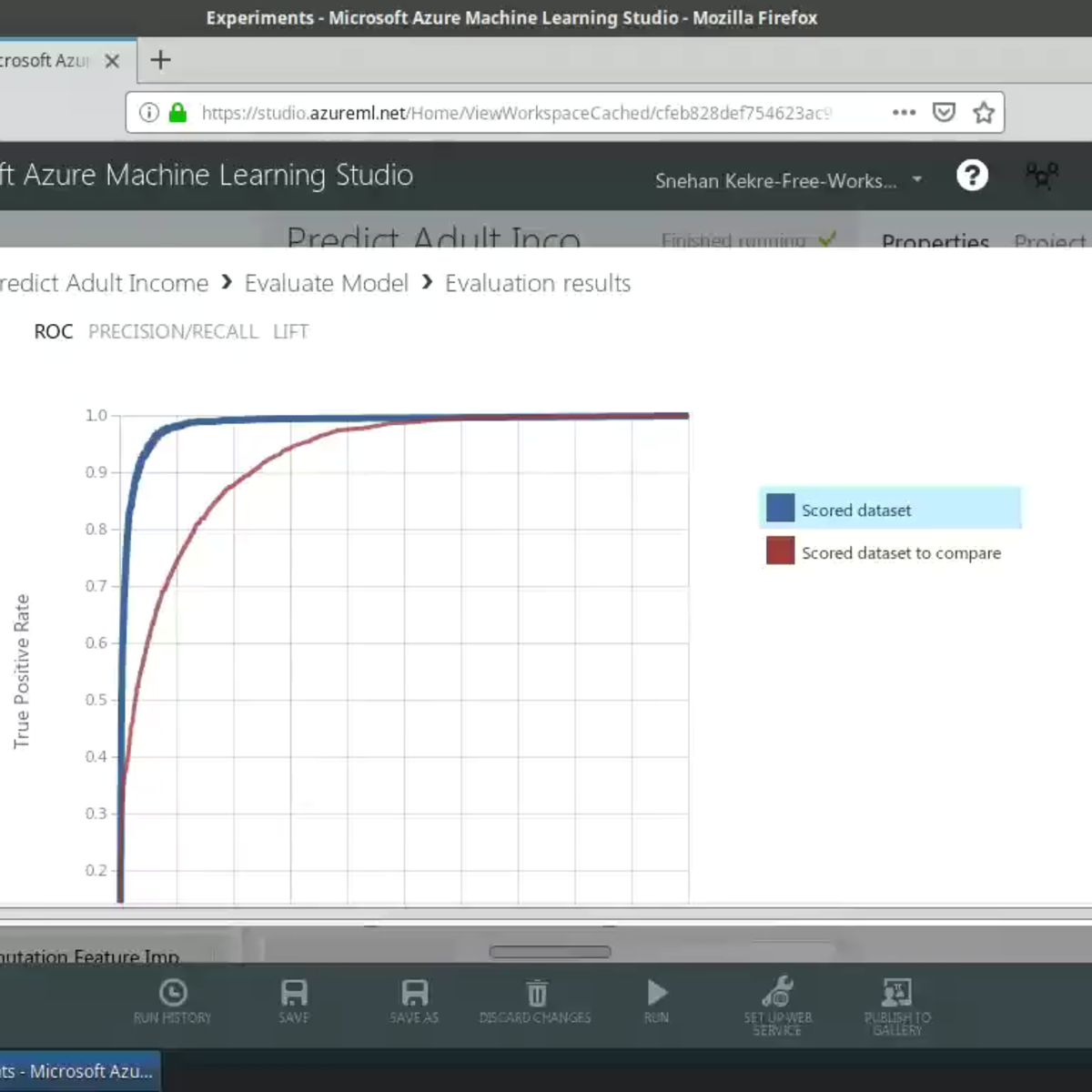
In this project-based course, you are going to build an end-to-end machine learning pipeline in Azure ML Studio, all without writing a single line of code! This course uses the Adult Income Census data set to train a model to predict an individual's income. It predicts whether an individual's annual income is greater than or less than $50,000. The estimator used in this project is a Two-Class Boosted Decision Tree classifier. Some of the features used to train the model are age, education, occupation, etc. Once you have scored and evaluated the model on the test data, you will deploy the trained model as an Azure Machine Learning web service. In just under an hour, you will be able to send new data to the web service API and receive the resulting predictions.

Read more

In this project-based course, you are going to build an end-to-end machine learning pipeline in Azure ML Studio, all without writing a single line of code! This course uses the Adult Income Census data set to train a model to predict an individual's income. It predicts whether an individual's annual income is greater than or less than $50,000. The estimator used in this project is a Two-Class Boosted Decision Tree classifier. Some of the features used to train the model are age, education, occupation, etc. Once you have scored and evaluated the model on the test data, you will deploy the trained model as an Azure Machine Learning web service. In just under an hour, you will be able to send new data to the web service API and receive the resulting predictions.

This is the second course in this series on building machine learning applications using Azure Machine Learning Studio. I highly encourage you to take the first course before proceeding. It has instructions on how to set up your Azure ML account with $200 worth of free credit to get started with running your experiments!

This course runs on Coursera's hands-on project platform called Rhyme. On Rhyme, you do projects in a hands-on manner in your browser. You will get instant access to pre-configured cloud desktops containing all of the software and data you need for the project. Everything is already set up directly in your internet browser so you can just focus on learning. For this project, you’ll get instant access to a cloud desktop with Python, Jupyter, and scikit-learn pre-installed.

Notes:

- You will be able to access the cloud desktop 5 times. However, you will be able to access instructions videos as many times as you want.

- This course works best for learners who are based in the North America region. We’re currently working on providing the same experience in other regions.

Enroll now

What's inside

Syllabus

Traffic lights

Read about what's good
what should give you pause
and possible dealbreakers
Introduces learners to foundational concepts of Machine Learning and Azure ML Studio
Develops skills in setting up and running experiments in Azure ML Studio
Guides learners to build and deploy an end-to-end machine learning pipeline
Students will send new data to the web service API to receive predictions
Learning is done within a cloud desktop environment that provides a hands-on experience

Save this course

Create your own learning path. Save this course to your list so you can find it easily later.
Save

Reviews summary

Azure ml pipelines: no-code & quick deployment

According to students, this course offers a highly practical and concise introduction to building machine learning pipelines in Azure ML Studio. Learners particularly appreciate the no-code approach, making it accessible to those without programming experience and enabling quick setup and deployment of models as web services. While it provides valuable hands-on experience, prospective students should be aware of certain limitations. The Rhyme cloud desktop access is limited to 5 sessions, which can be a significant challenge for troubleshooting or redoing steps. Furthermore, the course is currently best suited for learners in the North America region, with other regions facing potential accessibility issues. It serves as an excellent primer for Azure ML Studio deployment but does not delve into deep theoretical concepts, making it ideal for those seeking immediate practical application rather than academic depth.
Delivers key concepts efficiently within a short timeframe.
"I finished the entire project in under an hour, which is perfect for a busy schedule."
"It was a great way to quickly learn a specific skill without a long commitment."
"For someone looking for a quick practical intro, this course really hits the mark."
Benefits greatly from completing the preceding course in the series for setup.
"I strongly recommend taking the first course; it provided crucial setup instructions."
"Starting with the first course really helped me with the Azure ML account setup and credits."
"I was glad I took the introductory course first; it made this project much smoother."
Offers valuable hands-on experience in deploying ML models.
"Learning to deploy the model as a web service was incredibly useful for my work."
"The hands-on project showed me exactly how to make a model available via an API."
"I can now take what I learned and apply it to deploy my own models quickly."
Enables building ML pipelines without prior coding experience.
"I appreciate the 'no code' approach; it made machine learning accessible to me."
"It was amazing to build a complete pipeline just by dragging and dropping elements."
"Finally, an ML course where I didn't get bogged down in coding syntax!"
Focuses on practical application rather than deep theoretical understanding.
"While hands-on, the course doesn't delve deeply into the underlying ML algorithms."
"Don't expect extensive theoretical explanations; it's purely about building the pipeline."
"I found it great for quick implementation, but I still need to study ML theory separately."
The 5-session limit on cloud desktop access can be restrictive.
"The 5-session limit on the cloud desktop was very frustrating; I needed more time."
"I wish there were more attempts for the lab environment, as troubleshooting consumed my sessions."
"It felt like I was rushing to complete the project before my sessions ran out."
Course functionality is currently limited to learners in North America.
"As someone based outside North America, I was unable to access the full experience."
"It's disappointing that the course is region-locked; I hope they expand access soon."
"The regional restriction made it impossible for me to fully complete the hands-on part."

Activities

Be better prepared before your course. Deepen your understanding during and after it. Supplement your coursework and achieve mastery of the topics covered in Machine Learning Pipelines with Azure ML Studio with these activities:
Review Machine Learning Concepts
Refresh your knowledge of machine learning concepts to strengthen your foundation for this course.
Browse courses on Machine Learning
Show steps
  • Review your notes from previous machine learning courses or books.
  • Read articles and blog posts on machine learning topics.
  • Watch videos or tutorials on machine learning.
Practice Python coding basics
Reinforce Python coding fundamentals to enhance understanding of Azure ML Studio concepts.
Browse courses on Python
Show steps
  • Review Python syntax and data structures
  • Solve practice problems on code execution and manipulation
Follow Azure Machine Learning Studio Tutorials
Expand your knowledge of Azure Machine Learning Studio by following additional tutorials.
Show steps
  • Identify areas where you want to improve your skills.
  • Find relevant tutorials on the Azure Machine Learning Studio website.
  • Follow the tutorials step-by-step.
  • Apply what you've learned to your own projects.
Five other activities
Expand to see all activities and additional details
Show all eight activities
Attend an Azure Machine Learning Studio Workshop
Gain hands-on experience with Azure Machine Learning Studio in a workshop setting.
Show steps
  • Find an upcoming Azure Machine Learning Studio workshop in your area.
  • Register for the workshop.
  • Attend the workshop and participate actively.
  • Apply what you've learned to your own projects.
Join a Machine Learning Study Group
Enhance your learning by collaborating with peers in a study group.
Browse courses on Machine Learning
Show steps
  • Find or start a study group for machine learning.
  • Meet regularly with your group to discuss course materials.
  • Work together on projects and assignments.
  • Provide feedback and support to each other.
Practice Machine Learning Pipelines
Practice building machine learning pipelines to solidify your understanding of the process.
Show steps
  • Review the course materials on machine learning pipelines.
  • Find a dataset and prepare it for modeling.
  • Build a machine learning pipeline using Azure Machine Learning Studio.
  • Evaluate the performance of your pipeline.
  • Deploy your pipeline as a web service.
Create a Machine Learning Pipeline Diagram
Reinforce your understanding of machine learning pipelines by creating a visual representation.
Show steps
  • Identify the key steps in a machine learning pipeline.
  • Use a diagramming tool to create a visual representation of the pipeline.
  • Label each step with a brief description of its purpose.
  • Share your diagram with others for feedback.
Contribute to an Open Source Machine Learning Project
Deepen your understanding of machine learning by contributing to an open source project.
Browse courses on Machine Learning
Show steps
  • Find an open source machine learning project that interests you.
  • Identify an area where you can contribute.
  • Submit a pull request with your contribution.
  • Work with the project maintainers to get your contribution merged.

Career center

Learners who complete Machine Learning Pipelines with Azure ML Studio will develop knowledge and skills that may be useful to these careers:
Machine Learning Engineer
Machine Learning Engineers are responsible for designing, developing, and deploying machine learning models. This course can help you build the skills necessary to become a successful Machine Learning Engineer by providing you with a strong foundation in machine learning, data science, and Azure ML Studio. You will learn how to use Azure ML Studio to build end-to-end machine learning pipelines, which can be used to solve a variety of business problems. This course is a great way to get started in the field of machine learning engineering and gain the skills you need to succeed in this growing field.
Data Scientist
Data Scientists are responsible for using data to solve business problems. This course can help you build the skills necessary to become a successful Data Scientist by providing you with a strong foundation in machine learning, data science, and Azure ML Studio. You will learn how to use Azure ML Studio to build end-to-end machine learning pipelines, which can be used to solve a variety of business problems. This course is a great way to get started in the field of data science and gain the skills you need to succeed in this growing field.
Data Analyst
Data Analysts are responsible for collecting, cleaning, and analyzing data to help businesses make better decisions. This course can help you build the skills necessary to become a successful Data Analyst by providing you with a strong foundation in machine learning, data science, and Azure ML Studio. You will learn how to use Azure ML Studio to build end-to-end machine learning pipelines, which can be used to solve a variety of business problems. This course is a great way to get started in the field of data analytics and gain the skills you need to succeed in this growing field.
Business Analyst
Business Analysts are responsible for helping businesses make better decisions by understanding their needs and recommending solutions. This course can help you build the skills necessary to become a successful Business Analyst by providing you with a strong foundation in machine learning, data science, and Azure ML Studio. You will learn how to use Azure ML Studio to build end-to-end machine learning pipelines, which can be used to solve a variety of business problems. This course is a great way to get started in the field of business analysis and gain the skills you need to succeed in this growing field.
Software Engineer
Software Engineers are responsible for designing, developing, and deploying software applications. This course can help you build the skills necessary to become a successful Software Engineer by providing you with a strong foundation in machine learning, data science, and Azure ML Studio. You will learn how to use Azure ML Studio to build end-to-end machine learning pipelines, which can be used to solve a variety of business problems. This course is a great way to get started in the field of software engineering and gain the skills you need to succeed in this growing field.
Quantitative Analyst
Quantitative Analysts are responsible for using mathematical and statistical models to analyze financial data and make investment decisions. This course can help you build the skills necessary to become a successful Quantitative Analyst by providing you with a strong foundation in machine learning, data science, and Azure ML Studio. You will learn how to use Azure ML Studio to build end-to-end machine learning pipelines, which can be used to solve a variety of business problems. This course is a great way to get started in the field of quantitative analysis and gain the skills you need to succeed in this growing field.
Risk Analyst
Risk Analysts are responsible for identifying and assessing risks to businesses. This course can help you build the skills necessary to become a successful Risk Analyst by providing you with a strong foundation in machine learning, data science, and Azure ML Studio. You will learn how to use Azure ML Studio to build end-to-end machine learning pipelines, which can be used to solve a variety of business problems. This course is a great way to get started in the field of risk analysis and gain the skills you need to succeed in this growing field.
Product Manager
Product Managers are responsible for managing the development and launch of new products. This course may be useful for Product Managers who want to learn more about machine learning and how it can be used to improve product development. You will learn how to use Azure ML Studio to build end-to-end machine learning pipelines, which can be used to solve a variety of business problems. This course is a great way to gain the skills you need to succeed in the field of product management.
Marketing Manager
Marketing Managers are responsible for developing and executing marketing campaigns. This course may be useful for Marketing Managers who want to learn more about machine learning and how it can be used to improve marketing campaigns. You will learn how to use Azure ML Studio to build end-to-end machine learning pipelines, which can be used to solve a variety of business problems. This course is a great way to gain the skills you need to succeed in the field of marketing.
Sales Manager
Sales Managers are responsible for leading and managing sales teams. This course may be useful for Sales Managers who want to learn more about machine learning and how it can be used to improve sales performance. You will learn how to use Azure ML Studio to build end-to-end machine learning pipelines, which can be used to solve a variety of business problems. This course is a great way to gain the skills you need to succeed in the field of sales.
Operations Manager
Operations Managers are responsible for managing the day-to-day operations of a business. This course may be useful for Operations Managers who want to learn more about machine learning and how it can be used to improve operations. You will learn how to use Azure ML Studio to build end-to-end machine learning pipelines, which can be used to solve a variety of business problems. This course is a great way to gain the skills you need to succeed in the field of operations management.
Financial Analyst
Financial Analysts are responsible for analyzing financial data and making investment recommendations. This course may be useful for Financial Analysts who want to learn more about machine learning and how it can be used to improve investment analysis. You will learn how to use Azure ML Studio to build end-to-end machine learning pipelines, which can be used to solve a variety of business problems. This course is a great way to gain the skills you need to succeed in the field of financial analysis.
Human Resources Manager
Human Resources Managers are responsible for managing the human resources of a business. This course may be useful for Human Resources Managers who want to learn more about machine learning and how it can be used to improve human resources management. You will learn how to use Azure ML Studio to build end-to-end machine learning pipelines, which can be used to solve a variety of business problems. This course is a great way to gain the skills you need to succeed in the field of human resources management.
IT Manager
IT Managers are responsible for managing the information technology of a business. This course may be useful for IT Managers who want to learn more about machine learning and how it can be used to improve IT operations. You will learn how to use Azure ML Studio to build end-to-end machine learning pipelines, which can be used to solve a variety of business problems. This course is a great way to gain the skills you need to succeed in the field of IT management.
Customer Service Manager
Customer Service Managers are responsible for managing the customer service of a business. This course may be useful for Customer Service Managers who want to learn more about machine learning and how it can be used to improve customer service. You will learn how to use Azure ML Studio to build end-to-end machine learning pipelines, which can be used to solve a variety of business problems. This course is a great way to gain the skills you need to succeed in the field of customer service management.

Reading list

We've selected 15 books that we think will supplement your learning. Use these to develop background knowledge, enrich your coursework, and gain a deeper understanding of the topics covered in Machine Learning Pipelines with Azure ML Studio.
Serves as a comprehensive textbook on statistical learning. Covers topics such as linear regression, logistic regression, and decision trees. Provides a solid theoretical foundation for understanding machine learning concepts.
本书全面系统地介绍了自然语言处理的基本原理和算法,涵盖了词法分析、句法分析、语义分析、语用分析等内容。本书适合作为自然语言处理领域的教科书或参考书。
Provides a mathematical introduction to machine learning. Covers topics such as probability theory, Bayesian inference, and support vector machines. Suitable for readers with a strong background in mathematics and statistics.
Serves as a comprehensive guide to machine learning fundamentals. Covers essential concepts such as supervised and unsupervised learning, model evaluation, and feature engineering. Lays the foundation for understanding the techniques used in the course.
Presents machine learning from a probabilistic perspective. Covers topics such as Bayesian networks, Gaussian processes, and variational inference. Suitable for readers with a strong background in probability and statistics.
Provides a practical guide to machine learning using popular Python libraries such as Scikit-Learn, Keras, and TensorFlow. Covers topics such as supervised learning, unsupervised learning, and deep learning.
Offers a practical guide to machine learning. Covers topics such as data preparation, model selection, and model evaluation. Provides hands-on exercises and case studies.
Covers a wide range of machine learning techniques and algorithms. Provides detailed explanations and code examples in Python. Suitable for both beginners and experienced practitioners.
本书介绍了机器学习中常用的数学知识,涵盖了线性代数、概率论、统计学等内容。本书适合作为机器学习领域的基础读物。
Introduces the fundamentals of deep learning. Covers topics such as neural networks, convolutional neural networks, and recurrent neural networks. Provides practical examples and code snippets for implementing deep learning models in Python.
Offers a collection of recipes for common machine learning tasks. Provides code examples that can be easily adapted to the Azure ML Studio environment. Explores advanced topics such as natural language processing and deep learning.
Offers a practical guide to machine learning for programmers. Covers topics such as data cleaning, feature engineering, and model deployment. Provides hands-on examples and code snippets.
Provides a gentle introduction to machine learning using Python. It covers the basics of machine learning, such as data preparation, feature engineering, model training, and evaluation. The book also includes several case studies that demonstrate how to use Python to solve real-world problems.
Focuses on the business applications of machine learning. Discusses topics such as data collection, data analysis, and model deployment. Provides case studies and examples of how machine learning is used in various industries.

Share

Help others find this course page by sharing it with your friends and followers:

Similar courses

Similar courses are unavailable at this time. Please try again later.
Our mission

OpenCourser helps millions of learners each year. People visit us to learn workspace skills, ace their exams, and nurture their curiosity.

Our extensive catalog contains over 50,000 courses and twice as many books. Browse by search, by topic, or even by career interests. We'll match you to the right resources quickly.

Find this site helpful? Tell a friend about us.

Affiliate disclosure

We're supported by our community of learners. When you purchase or subscribe to courses and programs or purchase books, we may earn a commission from our partners.

Your purchases help us maintain our catalog and keep our servers humming without ads.

Thank you for supporting OpenCourser.

© 2016 - 2025 OpenCourser