We may earn an affiliate commission when you visit our partners.
Course image
Moses Gummadi

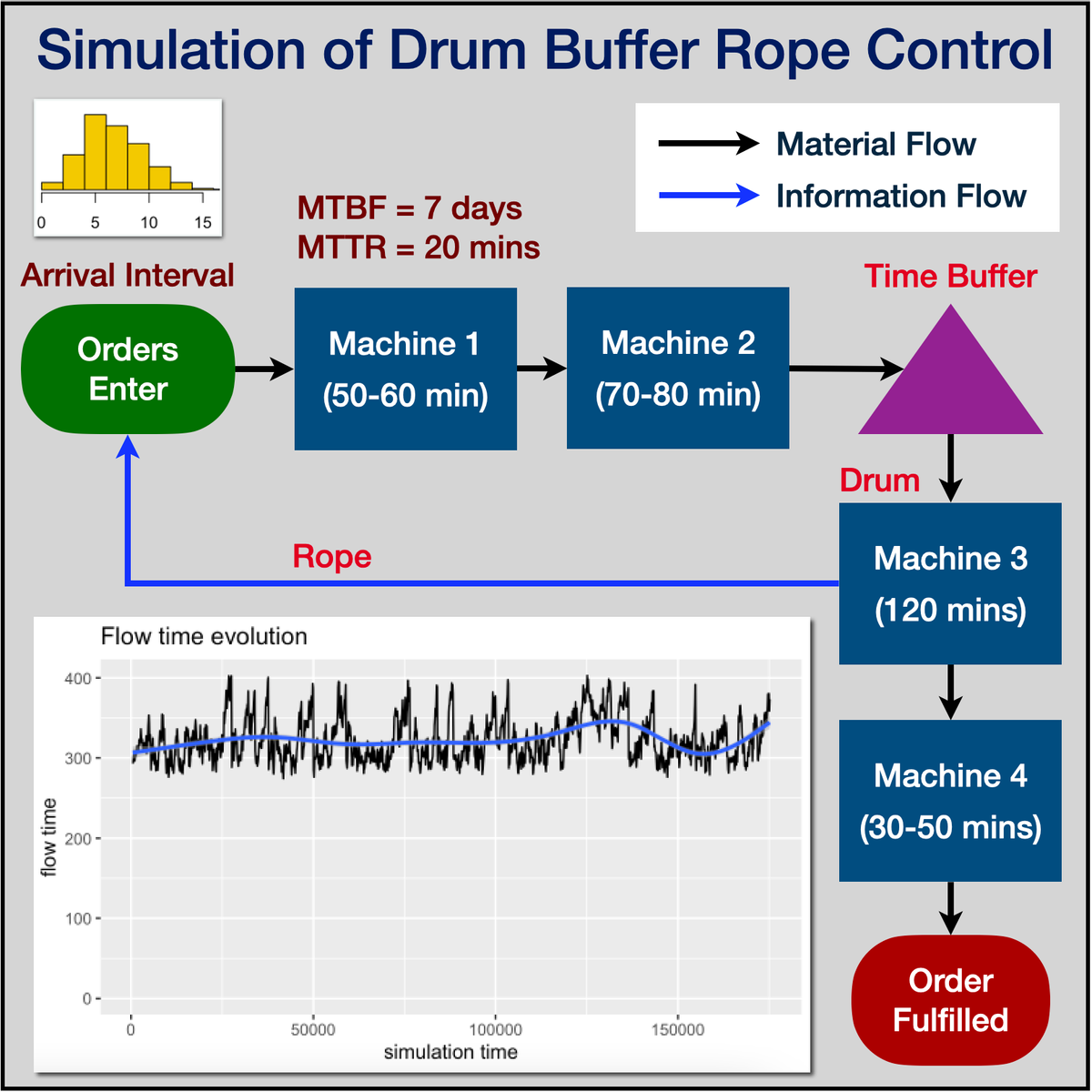
Welcome to "Simulation of Drum-Buffer-Rope Production Control Using R-Simmer". This is a project-based course which should take about 2 hours to finish. Before diving into the project, please take a look at the course objectives and structure. By the end of this project, you will gain introductiory knowledge of Drum-Buffer-Rope Production Control, Discrete Event Simulation, be able to use R Studio and Simmer library, create statistical variables required for simulation, define process trajectory, define and assign resources, define arrivals (eg. incoming customers / work units), run simulation in R, store results in data frames, plot charts and interpret the results.

Enroll now

What's inside

Syllabus

Traffic lights

Read about what's good
what should give you pause
and possible dealbreakers
Helps learners analyze production systems, which is relevant in manufacturing and operations management
Introduces R Studio and Simmer library, which are widely used tools for simulation modeling
Builds a strong foundation in Drum-Buffer-Rope Production Control, Discrete Event Simulation, and statistical modeling
Taught by Moses Gummadi, who are recognized for their work in the field
May require prior knowledge in R programming and statistics, which might be a barrier for some learners
Intended for learners with some background in production and operations management concepts

Save this course

Create your own learning path. Save this course to your list so you can find it easily later.
Save

Reviews summary

Practical dbr simulation with r simmer

According to learners, this course is likely a highly practical and concise introduction to applying Drum-Buffer-Rope control principles using the R Simmer library. Students appreciate the hands-on, project-based approach, which enables them to immediately implement discrete event simulations. While it provides a solid foundation for those familiar with basic R, some learners might find the introductory depth not sufficient for advanced or complex simulation scenarios. Overall, it serves as an excellent starting point for understanding and utilizing Simmer for operational challenges.
Prior R experience is beneficial for learners.
"While insightful, the course seemed to assume some prior basic R programming knowledge."
"I would suggest reviewing R fundamentals before starting if you're not comfortable with the language."
"A little more R syntax explanation would be helpful for absolute beginners."
Covers foundational concepts, not advanced topics.
"This course is a good starting point, but it doesn't delve into highly complex scenarios."
"I found it to be a valuable introduction, but not suited for those seeking advanced simulation techniques."
"It provides a solid overview, but further study is needed for mastery beyond the basics."
A short, direct path to specific skills.
"The 2-hour format was ideal for a quick, targeted skill acquisition."
"I appreciated that the course got straight to the point without any fluff."
"Perfect for busy professionals who need a focused overview of the topic."
Excellent first step into using the R Simmer library.
"It's a great initial guide to the Simmer library for operations analysis."
"I learned the essential functions in R Studio and Simmer for basic simulations."
"This course effectively introduced me to creating and running simulations with Simmer."
Provides practical experience in DBR simulation.
"I found the project-based structure very effective for hands-on learning."
"This course helped me immediately apply DBR principles to production control scenarios."
"The practical exercises using R Simmer were the strongest part of the learning experience."

Activities

Be better prepared before your course. Deepen your understanding during and after it. Supplement your coursework and achieve mastery of the topics covered in Simulation of Drum-Buffer-Rope Control Using R Simmer with these activities:
Review Discrete-Event Simulation (DES)
Review the basics of Discrete-Event Simulation (DES). DES is a fundamental concept that will be built upon in this course. Try not to skip this step to avoid confusion later.
Browse courses on DES
Show steps
  • Read about DES from an online source
  • Watch videos or tutorials on DES
  • Practice a few basic DES problems
R Studio and Simmer library practice
Practice using R Studio and Simmer library before starting the course. This will shorten the learning curve and provide a stronger foundation.
Browse courses on R Studio
Show steps
  • Install R Studio and Simmer library
  • Follow along with R Studio and Simmer library tutorials
  • Create some basic R scripts using Simmer library
Simmer library tutorials
Simmer is powerful for DES. Follow tutorials to become familiar with its key features and capabilities.
Browse courses on Simmer
Show steps
  • Search for Simmer tutorials on YouTube or other online resources
  • Follow along with the tutorials and practice the examples
  • Create your own small DES project using Simmer
Four other activities
Expand to see all activities and additional details
Show all seven activities
Drum-Buffer-Rope Production Control simulation project
The final project - a DES simulation of a Drum-Buffer-Rope Production Control system - benefits from early planning. Start thinking about the project.
Show steps
  • Review the course materials on Drum-Buffer-Rope Production Control
  • Think about how you can use the Simmer library to simulate the system
  • Sketch out a plan for your simulation project
Peer review of simulation projects
Get feedback on your simulation project from your peers. This can help you identify areas for improvement and ensure that your project is of high quality.
Browse courses on DES
Show steps
  • Find a peer who is also working on a simulation project
  • Share your project with your peer and ask for feedback
  • Provide feedback to your peer on their project
Drum-Buffer-Rope Production Control simulation report
Create a report that summarizes your findings from the DES simulation project. This will help solidify your understanding of the concepts and techniques covered in the course.
Show steps
  • Analyze the results of your simulation
  • Write a report that describes your simulation project, the results, and your conclusions
  • Present your report to your classmates or instructor
Contribute to Simmer library
Contribute to the Simmer library by submitting bug reports, documentation, or code contributions. This is a great way to give back to the community and deepen your understanding of the library.
Browse courses on Simmer
Show steps
  • Find an issue on the Simmer GitHub repository
  • Submit a bug report or pull request
  • Collaborate with other contributors to resolve the issue

Career center

Learners who complete Simulation of Drum-Buffer-Rope Control Using R Simmer will develop knowledge and skills that may be useful to these careers:
Industrial Engineer
Industrial Engineers work in every industry, designing, improving, and implementing systems that optimize efficiency. A course in the Simulation of Drum-Buffer-Rope Production Control can provide the necessary foundational knowledge in simulating production and manufacturing processes, as well as experience in R and Simmer, a valuable and sought-after skill set.
Production Planner
Production Planners work to optimize and coordinate production schedules, materials, and inventory. This course in the Simulation of Drum-Buffer-Rope Production Control can provide valuable, relevant knowledge by teaching how to simulate and optimize production processes, as well as experience with R and Simmer.
Process Engineer
Process Engineers are tasked with designing, improving, and implementing manufacturing processes. This course will help build a strong foundation for this career by giving experience in simulating and optimizing production processes using Drum-Buffer-Rope Production Control, as well as providing experience in R and Simmer.
Manufacturing Engineer
Manufacturing Engineers design, build, and maintain the physical systems used in the production of goods. This course in the Simulation of Drum-Buffer-Rope Production Control can provide foundational knowledge in the simulation of production processes, as well as experience in R and Simmer, which would be highly valuable in the field.
Quality Engineer
Quality Engineers work to improve and maintain the quality of products and services. A course in the Simulation of Drum-Buffer-Rope Production Control can provide valuable, relevant knowledge by teaching how to simulate and optimize production processes, as well as experience in R and Simmer, which is commonly used in the field.
Systems Engineer
Systems Engineers are tasked with designing and implementing complex systems, often with production or manufacturing processes involved. This course will help build strong analytical and simulation skills that are relevant to systems engineering by focusing on simulating Drum-Buffer-Rope Production Control, which is a key manufacturing concept.
Operations Research Analyst
An Operations Research Analyst will be tasked with improving processes to improve efficiency through operations analysis. With this course in Simulation of Drum-Buffer-Rope Production Control, you will learn how to simulate production processes to identify potential bottlenecks and how to address them. This will help build a foundation for process improvement.
Supply Chain Manager
Supply Chain Managers oversee the flow of goods and services from suppliers to customers. Experience in simulating production processes, such as what is taught in this course, provides a competitive advantage in the field.
Data Scientist
Data Science leverages simulations extensively to explore possible outcomes within a data-driven context, and simulation plays a key role in creating models for data analysis, which this course will help build a foundation for, as well as provide experience in R and Simmer.
Operations Manager
Operations Managers plan, organize, and control the day-to-day operations of a business. This course may be useful for learning how to optimize production processes and gain experience in Simmer, a valuable tool in the field.
Project Manager
Project Managers plan, execute, and close projects. Experience in simulation, such as what this course provides, can be valuable in certain project management roles, particularly those involving manufacturing or production.
Business Analyst
Business Analysts work to improve business processes. This course may be helpful in learning the basics of simulation and process optimization, as well as gaining experience in R and Simmer.
Software Engineer
Software Engineers design, build, and maintain software systems, often in the context of manufacturing or production. Experience in simulation, such as that provided in this course, can be beneficial in these roles.
Financial Analyst
Financial Analysts help businesses make informed financial decisions. While this course is not directly related to finance, the experience in simulation and process optimization can be transferable to certain roles.
Marketing Manager
Marketing Managers plan and execute marketing campaigns. This course is not directly related to marketing, but the experience in simulation and process optimization may be transferable to certain roles.

Reading list

We've selected seven books that we think will supplement your learning. Use these to develop background knowledge, enrich your coursework, and gain a deeper understanding of the topics covered in Simulation of Drum-Buffer-Rope Control Using R Simmer .
Provides a comprehensive overview of the Theory of Constraints (TOC) and how it can be used to improve manufacturing and business processes. It valuable resource for anyone who wants to learn more about TOC and how it can be applied in practice.
Fictionalized account of how TOC is used to improve a manufacturing plant. It great way to learn about TOC in a practical and engaging way. The authors are experts in TOC and provide a clear and concise explanation of the concepts.
Provides a comprehensive overview of simulation modeling and analysis. It valuable resource for anyone who wants to learn more about simulation and how it can be used to model and analyze complex systems.
Provides an introduction to using R for simulation. It valuable resource for anyone who wants to learn more about simulation and how it can be used to model and analyze business processes.
Provides a practical guide to using simulation for decision making. It valuable resource for anyone who wants to learn more about simulation and how it can be used to make better decisions.
Provides a comprehensive overview of using Arena, a simulation software package. It valuable resource for anyone who wants to learn more about simulation and how it can be used to model and analyze business processes.
Provides a comprehensive overview of discrete-event system simulation. It valuable resource for anyone who wants to learn more about simulation and how it can be used to model and analyze business processes.

Share

Help others find this course page by sharing it with your friends and followers:

Similar courses

Similar courses are unavailable at this time. Please try again later.
Our mission

OpenCourser helps millions of learners each year. People visit us to learn workspace skills, ace their exams, and nurture their curiosity.

Our extensive catalog contains over 50,000 courses and twice as many books. Browse by search, by topic, or even by career interests. We'll match you to the right resources quickly.

Find this site helpful? Tell a friend about us.

Affiliate disclosure

We're supported by our community of learners. When you purchase or subscribe to courses and programs or purchase books, we may earn a commission from our partners.

Your purchases help us maintain our catalog and keep our servers humming without ads.

Thank you for supporting OpenCourser.

© 2016 - 2025 OpenCourser