We may earn an affiliate commission when you visit our partners.
Course image
Moses Gummadi

Welcome to RStudio for Six Sigma - Control Charts. This is a project-based course which should take under 2 hours to finish. Before diving into the project, please take a look at the course objectives and structure.

Read more

Welcome to RStudio for Six Sigma - Control Charts. This is a project-based course which should take under 2 hours to finish. Before diving into the project, please take a look at the course objectives and structure.

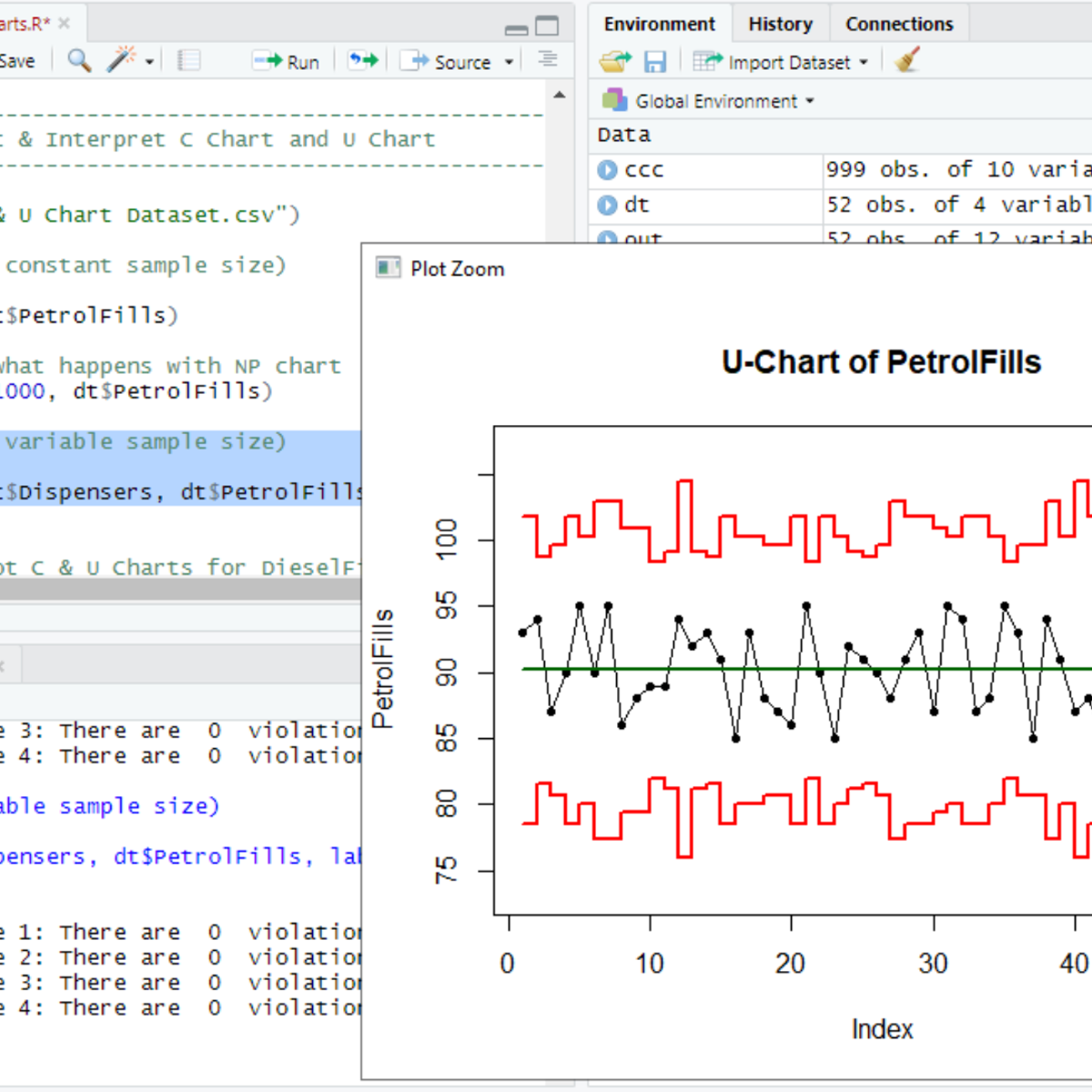
By the end of this project, you will learn to identify data types (Variables, Attribute Type I & II), understand the overview of Statistical Process Control, pick the right Control Chart based on the data type and other criteria, plot and interpret control charts. This Guided Project covers IMR Charts (XMR), Xbar-R Charts, Xbar-S Charts, NP Chart, P Chart, C Chart and U Chart. You will also learn about Western Electric Rules and Nelson's rules used to interpret the stability of the process.

Enroll now

What's inside

Syllabus

Traffic lights

Read about what's good
what should give you pause
and possible dealbreakers
Delves into essential topics of process control, such as data types, statistical process control, and control chart selection
Offers practical insights through a project-based structure, allowing learners to apply their learnings
Suitable for learners involved in process improvement or quality assurance roles
Taught by Moses Gummadi, an experienced instructor in the field of Six Sigma
Assumes prior knowledge in statistics and process control, which may not be suitable for complete beginners
Focuses primarily on control charts, so learners seeking a broader understanding of Six Sigma may need to supplement with other resources

Save this course

Create your own learning path. Save this course to your list so you can find it easily later.
Save

Reviews summary

Practical rstudio six sigma control charts

According to learners, this course offers a highly practical and hands-on approach to implementing various control charts in RStudio, making it ideal for professionals in quality assurance and process improvement. Students particularly praise the clear explanations of control chart types and interpretation rules like Western Electric and Nelson's rules, and find the project-based format very effective for immediate application. While it provides a quick and efficient guide for using R, some reviews suggest the course assumes prior statistical or Six Sigma knowledge, potentially making it challenging for absolute beginners to the theoretical concepts. Overall, it's a valuable resource for those seeking to enhance their RStudio skills for Six Sigma applications.
A short, focused, project-based learning experience.
"Excellent guided project. Short, to the point, and highly practical."
"Perfect for a quick practical guide. I was able to apply what I learned quickly."
"Good course for beginners in Six Sigma and RStudio. It covers the basics effectively, making it a quick learning experience."
Instructor provides clear explanations and helpful examples.
"The instructor explains complex concepts clearly and the RStudio examples are easy to follow."
"The instructor was clear, and the code was well-explained. The guided format is a big plus."
"As someone with some statistical background, I found it easy to follow. The visual demonstrations were helpful."
Covers various control chart types and interpretation rules.
"I particularly liked the variety of control charts covered and how to interpret them using Western Electric and Nelson's rules."
"Outstanding. Covered all the important chart types and the rules for interpretation. The RStudio integration was seamless."
"The emphasis on interpretation rules is very valuable for my quality assurance role."
Focuses on hands-on implementation of control charts in R.
"This is a fantastic course! Very practical and hands-on, which is exactly what I needed. The RStudio examples are easy to follow."
"Excellent guided project. Short, to the point, and highly practical. I learned to implement various control charts in RStudio."
"Perfect for a quick practical guide. I wanted to transition my control charting to R, and this course provided exactly that."
Requires existing understanding of Six Sigma or statistics.
"The course is okay, but I found the explanation of the underlying statistical concepts a bit lacking. It jumps right into RStudio without much theory."
"I felt like I needed more prior knowledge of both R and Six Sigma concepts than what was stated as prerequisites."
"The course assumes a lot of prior knowledge about Six Sigma. It doesn't explain the 'why' behind the charts very well, just the 'how'."

Activities

Be better prepared before your course. Deepen your understanding during and after it. Supplement your coursework and achieve mastery of the topics covered in RStudio for Six Sigma - Control Charts with these activities:
Review the basics of probability and statistics
This course builds on your understanding of probability and statistics. Reviewing these concepts will better prepare for the more advanced topics covered in this course.
Browse courses on Probability
Show steps
  • Review notes from a previous probability and statistics course
  • Review textbooks or online resources on probability and statistics
  • Practice solving probability and statistics problems
Complete the online tutorial on control charts
This course will introduce you to different types of control charts. Completing this tutorial will give you a solid foundation in control charts and help you understand the concepts covered in this course.
Browse courses on Control Charts
Show steps
  • Find an online tutorial on control charts
  • Complete the tutorial, taking notes on important concepts
  • Review your notes and practice applying the concepts to real-world data
Practice ploting and interpreting control charts
Plotting and interpreting control charts is an essential skill in this course. Completing these practice drills will help you develop proficiency in these skills and improve your understanding of the material.
Browse courses on Data Analysis
Show steps
  • Find a dataset that contains control chart data
  • Plot the control chart using a statistical software package
  • Interpret the control chart and identify any patterns or trends
Two other activities
Expand to see all activities and additional details
Show all five activities
Create a control chart for a real-world process
Applying the concepts of control charts to real-world processes is a valuable way to solidify your understanding. Completing this project will give you hands-on experience in creating and using a control chart to improve a process.
Browse courses on Data Analysis
Show steps
  • Identify a real-world process that you can monitor using a control chart
  • Collect data from the process
  • Plot the control chart using a statistical software package
  • Interpret the control chart and make recommendations for process improvement
Contribute to the RStudio for Six Sigma - Control Charts project
Contributing to open-source projects is a fantastic way to learn new skills and deepen your understanding of the material. Participating in this project will allow you to apply the concepts learned in this course and contribute to the community.
Browse courses on RStudio
Show steps
  • Find an issue or feature request that you can work on
  • Fork the repository and clone it to your local machine
  • Make the necessary changes to the code
  • Submit a pull request with your changes

Career center

Learners who complete RStudio for Six Sigma - Control Charts will develop knowledge and skills that may be useful to these careers:
Six Sigma Black Belt
Six Sigma Black Belts are responsible for leading and implementing Six Sigma projects, which are designed to improve the quality and efficiency of products and services. This course may be useful to a Six Sigma Black Belt by providing an overview of SPC and how to use control charts to monitor and maintain the quality of products or services.
Quality Engineer
Quality Engineers work to improve the quality and efficiency of products and services. This course may be useful to a Quality Engineer by providing an overview of SPC and how to use control charts to monitor and maintain the quality of products or services.
Quality Assurance Analyst
Quality Assurance Analysts identify and solve problems that may arise during the production process to ensure that products meet specifications. This course may be useful to a Quality Assurance Analyst by providing an overview of Statistical Process Control (SPC) and how to use control charts to monitor and maintain the quality of products or services.
Process Engineer
Process Engineers design and improve processes to ensure that they are efficient and effective. This course may be useful to a Process Engineer by providing an overview of SPC and how to use control charts to monitor and maintain the quality of products or services.
Manufacturing Engineer
Manufacturing Engineers design and improve manufacturing processes to ensure that they are efficient and effective. This course may be useful to a Manufacturing Engineer by providing an overview of SPC and how to use control charts to monitor and maintain the quality of products or services.
Industrial Engineer
Industrial Engineers design and improve industrial processes to ensure that they are efficient and effective. This course may be useful to an Industrial Engineer by providing an overview of SPC and how to use control charts to monitor and maintain the quality of products or services.
Production Manager
Production Managers are responsible for the production of goods and services. This course may be useful to a Production Manager by providing an overview of SPC and how to use control charts to monitor and maintain the quality of products or services.
Operations Manager
Operations Managers are responsible for the day-to-day operations of a business. This course may be useful to an Operations Manager by providing an overview of SPC and how to use control charts to monitor and maintain the quality of products or services.
Quality Control Inspector
Quality Control Inspectors are responsible for inspecting products and services to ensure that they meet specifications. This course may be useful to a Quality Control Inspector by providing an overview of SPC and how to use control charts to monitor and maintain the quality of products or services.
Data Analyst
Data Analysts collect, analyze, and interpret data to help businesses make better decisions. This course may be useful to a Data Analyst by providing an overview of SPC and how to use control charts to monitor and maintain the quality of products or services.
Statistician
Statisticians collect, analyze, and interpret data to help businesses make better decisions. This course may be useful to a Statistician by providing an overview of SPC and how to use control charts to monitor and maintain the quality of products or services.
Business Analyst
Business Analysts help businesses improve their performance by identifying and solving problems. This course may be useful to a Business Analyst by providing an overview of SPC and how to use control charts to monitor and maintain the quality of products or services.
Project Manager
Project Managers are responsible for planning, executing, and closing projects. This course may be useful to a Project Manager by providing an overview of SPC and how to use control charts to monitor and maintain the quality of products or services.
Software Quality Assurance Engineer
Software Quality Assurance Engineers are responsible for ensuring that software meets specifications. This course may be useful to a Software Quality Assurance Engineer by providing an overview of SPC and how to use control charts to monitor and maintain the quality of software.
Quality Management Consultant
Quality Management Consultants help businesses improve their quality management systems. This course may be useful to a Quality Management Consultant by providing an overview of SPC and how to use control charts to monitor and maintain the quality of products or services.

Reading list

We've selected six books that we think will supplement your learning. Use these to develop background knowledge, enrich your coursework, and gain a deeper understanding of the topics covered in RStudio for Six Sigma - Control Charts.
Comprehensive guide to Six Sigma, including a detailed discussion of control charts. It valuable resource for those who want to learn more about the practical application of Six Sigma.
Provides a comprehensive overview of statistical quality control, including a detailed discussion of control charts. It valuable resource for those who want to learn more about the theoretical foundations of statistical quality control.
Provides a comprehensive guide to Six Sigma, including a detailed discussion of control charts. It valuable resource for those who want to learn more about the practical application of Six Sigma.
Provides a comprehensive overview of statistical process control in manufacturing. It valuable resource for those who want to learn more about the theoretical foundations of statistical process control in manufacturing.
Provides a comprehensive overview of statistical quality control. It valuable resource for those who want to learn more about the theoretical foundations of statistical quality control.

Share

Help others find this course page by sharing it with your friends and followers:

Similar courses

Similar courses are unavailable at this time. Please try again later.
Our mission

OpenCourser helps millions of learners each year. People visit us to learn workspace skills, ace their exams, and nurture their curiosity.

Our extensive catalog contains over 50,000 courses and twice as many books. Browse by search, by topic, or even by career interests. We'll match you to the right resources quickly.

Find this site helpful? Tell a friend about us.

Affiliate disclosure

We're supported by our community of learners. When you purchase or subscribe to courses and programs or purchase books, we may earn a commission from our partners.

Your purchases help us maintain our catalog and keep our servers humming without ads.

Thank you for supporting OpenCourser.

© 2016 - 2025 OpenCourser