May 1, 2024
Updated November 13, 2026
4 minute read

Chat GPT is a large language model that has taken the world by storm. It is capable of generating human-like text, translating languages, writing different kinds of creative content, and even answering your questions in a conversational way. There are many reasons why you might want to learn about Chat GPT. Perhaps you are curious about how it works, or you are interested in using it to improve your own writing. Whatever your reasons, there are many ways to learn about Chat GPT, including online courses.
What is Chat GPT?
Chat GPT is a type of artificial intelligence (AI) known as a large language model (LLM). It was developed by OpenAI, a research company focused on developing friendly AI. Chat GPT is trained on a massive dataset of text and code, which allows it to understand and generate human-like language.
Chat GPT can be used for a variety of tasks, including:
-
Generating text: Chat GPT can generate text in a variety of styles, including creative writing, news articles, and marketing copy.
-
Translating languages: Chat GPT can translate text between over 100 languages.
-
Answering questions: Chat GPT can answer questions on a wide range of topics, from history to science to current events.
-
Writing different kinds of creative content: Chat GPT can write poems, songs, scripts, and other types of creative content.
Why learn about Chat GPT?
There are many reasons why you might want to learn about Chat GPT. Perhaps you are curious about how it works, or you are interested in using it to improve your own writing. Whatever your reasons, there are many ways to learn about Chat GPT, including online courses.
How to learn about Chat GPT
There are many ways to learn about Chat GPT. You can read articles and blog posts about it, watch videos, or take an online course. If you are interested in taking an online course, there are many available. Some of the most popular courses include:
fqm7hb|
Find a path to becoming a Chat GPT. Learn more at:
OpenCourser.com/topic/fqm7hb/chat
Reading list
We've selected 20 books
that we think will supplement your
learning. Use these to
develop background knowledge, enrich your coursework, and gain a
deeper understanding of the topics covered in
Chat GPT.
Wharton professor Ethan Mollick delivers the essential human-AI collaboration playbook for ChatGPT users. Explains the jagged frontier of model capabilities, four core principles for co-intelligence, and practical workflows for writing, brainstorming, research, and strategic decision-making.
Systematic O'Reilly framework that moves ChatGPT practitioners beyond brittle prompt hacks into repeatable engineering. Covers direction setting, few-shot exemplars, structured output formatting, chain-of-thought reasoning, and automated evaluation across text and multimodal workflows.
Authoritative systems blueprint for turning ChatGPT-class foundation models into dependable production software. Guides builders through prompt engineering, retrieval-augmented generation, fine-tuning trade-offs, latency optimization, and rigorous evaluation pipelines.
Visual, intuitive tour of the transformer architecture, tokenization, and embedding spaces powering ChatGPT. Equips learners with clear mental models and runnable Python examples for semantic search, text generation, RAG, and parameter-efficient fine-tuning.
Crafted by early GitHub Copilot architects, exploring how to design prompts programmatically as first-class software interfaces. Teaches context window budgeting, dynamic snippet assembly, grounding strategies, and deterministic output parsing for GPT-style models.
Hands-on PyTorch engineering journey that demystifies ChatGPT by coding a GPT-style transformer from the ground up. Walks through byte-pair tokenization, multi-head self-attention, pretraining loops, and instruction fine-tuning for conversational alignment.
Seminal treatise by UC Berkeley AI pioneer Stuart Russell examining why maximizing fixed objectives fails and how machines must learn human preferences instead. Provides the conceptual bedrock behind reinforcement learning from human feedback (RLHF) that makes ChatGPT safe and helpful.
Focused developer handbook for building Python applications atop OpenAI's ChatGPT and GPT-4 APIs. Demonstrates chat completions, function calling, structured JSON modes, embeddings, RAG architectures, and fine-tuning through clear, production-minded code examples.
Accessible, balanced primer explaining how ChatGPT and modern generative models work alongside their real-world risks and capabilities. Covers prompt design, hallucination mitigation, copyright, privacy, and organizational adoption without requiring deep math.
Standard Stanford computational linguistics textbook anchoring ChatGPT in decades of natural language processing theory. Rigorously covers language modeling, vector semantics, neural sequence models, transformers, attention mechanisms, and dialogue systems.
Practical everyday handbook for getting sharper, more reliable results from ChatGPT across writing, coding, analysis, and creative ideation. Introduces role framing, iterative refinement, chain-of-thought cues, and custom GPT workflows for non-specialists.
Modern 2025 Manning playbook tailored to systems engineers, analysts, and technical practitioners integrating ChatGPT into daily operations. Covers prompt automation, documentation drafting, scripting assistance, data governance, and enterprise security guardrails.
Forward-looking O'Reilly manual showing how conversational models like ChatGPT evolve into autonomous, tool-using AI agents. Details multi-agent orchestration, memory architectures, reflection loops, API tool integration, and agent evaluation strategies.
Project-oriented Python guide to OpenAI's developer ecosystem beyond the ChatGPT web interface. Walks through the Assistants API, Whisper speech recognition, DALL-E image generation, custom embeddings, and deploying end-to-end conversational web services.
Gripping narrative connecting cognitive science, fairness research, and reinforcement learning to explain why aligning language models with human intent is so difficult. Essential context for understanding reward modeling, bias, and RLHF in ChatGPT.
Executive-friendly survey of how ChatGPT and generative AI reshape marketing, customer service, healthcare, finance, and creative knowledge work. Provides concrete case studies, productivity patterns, and governance considerations for business adopters.
Lucid, concise technical essay by scientist Stephen Wolfram unpacking how ChatGPT predicts one token at a time yet produces coherent reasoning. Explains embeddings, semantic grammar, neural net training, and computational irreducibility without heavy code.
Hilarious, eye-opening exploration of how machine learning algorithms actually interpret prompts and fail in unexpected ways. Builds lasting intuition for why ChatGPT hallucinates, overfits patterns, and excels at creative remixing rather than literal truth.
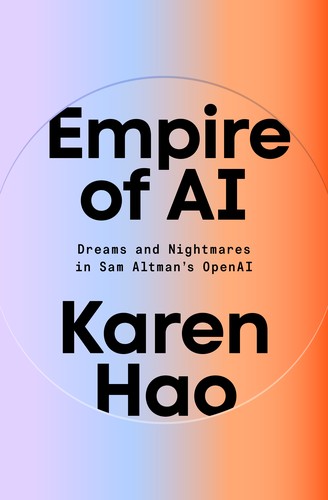
Deeply reported 2025 investigation chronicling the inside history of OpenAI, the creation of ChatGPT, and the shift from nonprofit safety lab to commercial juggernaut. Essential societal context on compute scaling, data labor, and AI governance.
Khan Academy founder Salman Khan shares firsthand lessons from building GPT-4-powered tutoring tools in classrooms. Demonstrates how ChatGPT can act as a Socratic writing coach and personalized study partner while safeguarding critical thinking.
For more information about how these books relate to this course, visit:
OpenCourser.com/topic/fqm7hb/chat

 Save